LinkedIn Post Readability: A Checklist for Thought Leadership That Gets Read

- social copy
- B2B
- readability
Hook patterns, line breaks, comment-friendly endings, and how to avoid AI-shaped posts—without sacrificing depth on professional topics.
Hooks and format for the feed
Feed reality
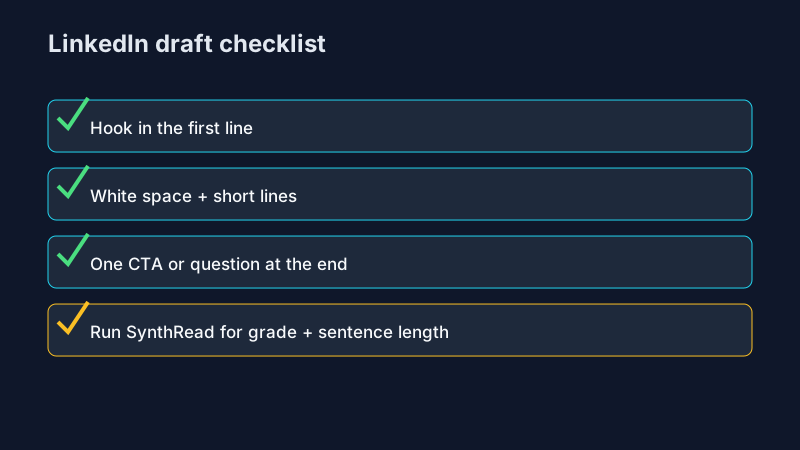
Readers decide in one to two lines whether to expand. Lead with a specific claim, number, or contrarian question tied to your expertise—avoid generic “In today’s fast-paced world” openers (see clichés).
Line breaks and rhythm
Short lines aren’t “dumbing down”; they’re rhythm for mobile. Alternate insight → example → takeaway. Use numbered lists sparingly so they still feel special.
First line vs. above-the-fold
The first line is the headline; the second should pay it off or add proof—don’t bury the concrete detail below a vague setup.
Depth and authenticity
Nuance without walls of text
If you need nuance, tease the framework early, then deliver three bullets max in-feed. Link to a long-form piece for the rest. Keeps the post scannable while preserving rigor.
AI-shaped prose
Uniform parallelisms and vague superlatives trigger skepticism. Run drafts through AI detection when you want a sanity check, then rewrite for personal examples only you could cite.
Credibility without a resume dump
One specific win or failure beats a list of credentials in the hook—save titles for the comment thread or your profile.
Engagement
Comments over performative CTAs
End with a real question you’re curious about, not “Agree?” spam. Comments reward posts that feel conversational, not performative.
Format experiments that stay on-brand
Try one structural change at a time (carousel vs. text, short vs. long) so you learn what your audience responds to without abandoning voice.
When to move nuance off-platform
If the post needs more than ~8–12 short lines of depth, tease and link to a blog or doc—feed readers get the thesis; specialists get the proof.
Related reading

Itamar Haim
SEO & GEO Lead, SynthQuery
Founder of SynthQuery and SEO/GEO lead. He helps teams ship content that reads well to humans and holds up under AI-assisted search and detection workflows.
He has led organic growth and content strategy engagements with companies including Elementor, Yotpo, and Imagen AI, combining technical SEO with editorial quality.
He writes SynthQuery's public guides on E-E-A-T, AI detection limits, and readability so editorial teams can align practice with how search and generative systems evaluate content.
Related Posts
Email Newsletter Readability: Subject Lines, Skims, and Mobile Layouts
How subscribers actually read email, concrete targets for preview text and body copy, and design choices that make readability scores translate to clicks.
Ad Copy That Converts: AI-Powered Copywriting Guide
A practical guide to AI ad copy writing: adoption trends, formats AI handles best, workflows that pair strategy with variants, FTC-safe disclosure, and how to use the SynthQuery Ad Copy tool with prompts and measurement.
Jargon vs. Precision in B2B Writing: When to Keep Technical Terms
A framework for deciding which specialized terms earn their place, how to introduce them without losing skimmers, and how readability scores should differ by funnel stage.
Get the best of SynthQuery
Tips on readability, AI detection, and content strategy. No spam.