Cringe AI Phrases to Edit Out of Marketing and Support Copy

- AI writing
- editing
- tone
- marketing
Stock phrases that make drafts sound machine-shaped, faster rewrites that keep the idea, and why a quick detection pass is a style tool—not just security.
Why these patterns spread
Safe, symmetrical model defaults
Models favor safe, symmetrical constructions: delve, landscape, robust, unlock, leverage, tapestry. Alone they’re fine; stacked, they read as generic thought leadership.
Why marketing and support copy shows it first
Landing pages and macros repeat the same safe patterns at scale—so readers notice “AI voice” faster than in one-off essays.
Detection as a style linter
A quick AI detection pass can flag uniformity before you ship—use it like a linter, not a verdict about authorship.
Faster rewrites that keep the insight
Quick swaps
In today’s fast-paced world → state the actual change (Since remote work doubled support volume…). It’s important to note → say the note. Game-changer → name the outcome with a metric or example.
Keep the argument, change the shape
Don’t throw away a good argument—reshape it with specific nouns and one human anecdote only you can supply. That’s what breaks the “AI slop” feel.
One concrete detail beats a synonym swap
Replace landscape and unlock with numbers, customer names, or dates—specificity does more than rotating adjectives.
Editorial process
Humanizer, detection, readability
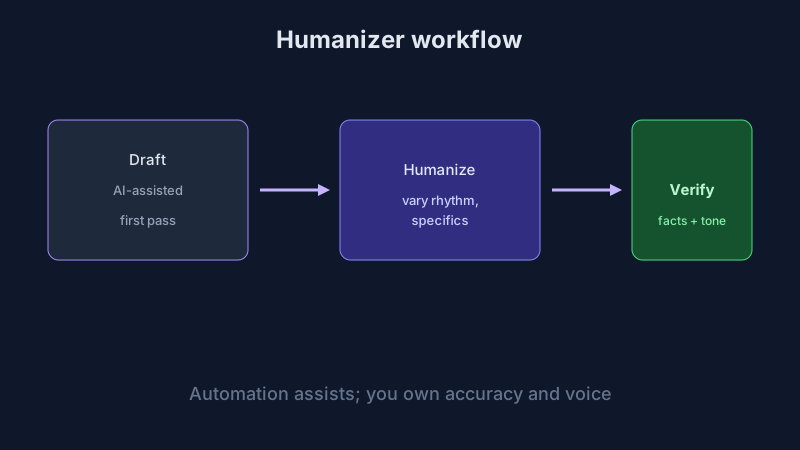
Draft with AI if you want, then run humanizer or manual passes for cadence. Optionally scan with AI detection to spot uniformity. Finish in SynthRead for sentence length.
Banned phrases in your voice guide
Add repeat offenders to your voice and tone guide so the team stops reintroducing the same stock phrases every sprint.
Final read for tone and risk
Have a human scan for humor, cultural references, and claims that read grammatical but wrong for your brand.
Related reading


Itamar Haim
SEO & GEO Lead, SynthQuery
Founder of SynthQuery and SEO/GEO lead. He helps teams ship content that reads well to humans and holds up under AI-assisted search and detection workflows.
He has led organic growth and content strategy engagements with companies including Elementor, Yotpo, and Imagen AI, combining technical SEO with editorial quality.
He writes SynthQuery's public guides on E-E-A-T, AI detection limits, and readability so editorial teams can align practice with how search and generative systems evaluate content.
Related Posts
What Is SynthID? Google's Multimodal AI Watermarking Explained
SynthID is Google DeepMind's watermarking and provenance technology for AI-generated images, audio, and video—not a generic 'AI detector.' Here's what it does, how it differs from statistical text checks, and what it means for publishers.
AI Content Detection in Journalism: How Newsrooms Verify Source Material
How journalism organizations use AI detection, wire-service policies, ethics codes, and workflows to protect trust—from breaking news to tips and comments—without treating classifiers as proof.
AI Detection API: How to Integrate AI Content Scanning Into Your Workflow
A developer-focused guide to integrating SynthQuery’s AI detection API: endpoints, auth, rate limits, Python/Node/cURL examples, WordPress and Google Docs patterns, batch jobs, score thresholds, and pricing-aware optimization.
Get the best of SynthQuery
Tips on readability, AI detection, and content strategy. No spam.