AI Detection for Educators: A Complete Classroom Guide (2026)

- AI detection for teachers
- education
- academic integrity
- classroom policy
- FERPA
A practical guide for high school and university instructors on using AI detection responsibly: statistics, pedagogy, interpreting scores, policy templates, assessment design, student conversations, FERPA-aware practice, and how tools compare—including SynthQuery workflows that scale.
Why this guide exists
Teaching got harder—fast
AI detection for teachers is now a search you run at midnight, not a theoretical debate. Students are using generative AI at scale; institutions are rewriting syllabi; and detectors sit awkwardly between signal, stress, and fairness. This guide is for educators who want clarity without turning a probability score into a verdict.
What you will get
- A grounded picture of how students actually use AI (with citations you can paste into committee memos).
- A pedagogical frame: why detection is never the whole answer.
- Interpretation rules for classifier output, policy language you can adapt, assessment moves that reduce cheating incentives, and when not to run a detector at all.
- A decision tree, policy template, and a tool comparison table—plus how SynthQuery fits team workflows.
Table of contents
- The current state of AI in education (2024–2026)
- Why AI detection alone is not a complete solution
- How to interpret AI detection results
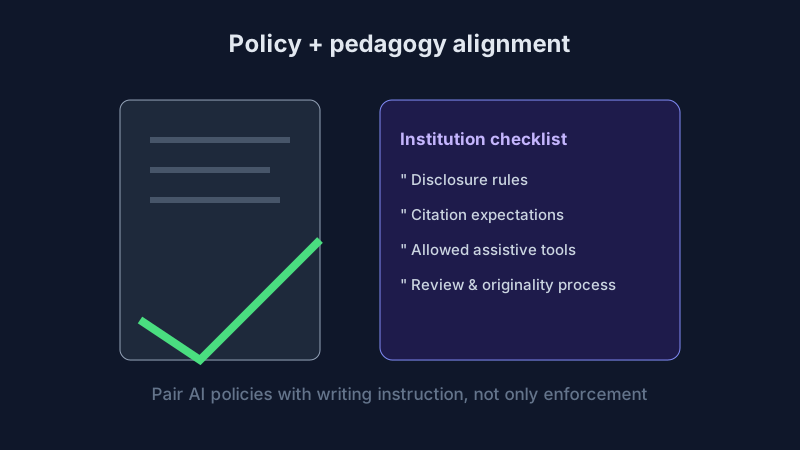
- Building an AI policy for your classroom
- Alternative assessment strategies
- When to use AI detection—and when not to
- How to talk with students about AI use
- Legal and ethical considerations
- Comparing AI detection tools for education
- SynthQuery for educators
The current state of AI in education (2024–2026)
Students are already using generative AI
Research aggregated across multiple surveys suggests that generative AI is normal for many learners—not a fringe behavior. In Turnitin’s Crossroads: Navigating the Intersection of AI in Education (2025) survey work, 64% of students reported being worried about AI’s use in education—compared with 50% of educators and 41% of administrators—which complicates simple “students vs. faculty” narratives. The same synthesis reports that 63% of students say using AI to write an entire piece of work is cheating—compared with 55% of faculty and 45% of administrators—a useful reminder that student ethics are not uniformly “relaxed,” even when tool use is widespread. (Turnitin)
The HEPI (Higher Education Policy Institute) Student Generative AI Survey (2025)—summarized in Turnitin’s analysis—reports that 88% of students have used generative AI in assignments, with only 18% saying they paste AI-generated text directly into assessments; common uses include explaining concepts, summarizing articles, and suggesting research ideas. That distinction matters: use is not the same as misconduct. (Turnitin, citing HEPI)
Teens and schoolwork (United States)
Pew Research Center surveys show rapid adoption of ChatGPT for school-adjacent work among U.S. teens: for example, roughly one-quarter of teens reported using ChatGPT for schoolwork in 2024, roughly double the share in 2023. Teens also draw sharp lines between acceptable uses (e.g., researching a topic) and unacceptable ones (e.g., writing essays), which is a teaching opportunity for syllabus design. (Pew Research Center)
Stanford-area research on student practice
Stanford’s SCALE initiative and related studies have documented how undergraduates integrate tools like ChatGPT into study workflows—often for help-seeking, drafting, and language refinement—not as a single “cheat button.” Separate work on computing students shows large year-over-year shifts in how commonly ChatGPT is used as a help resource alongside traditional search. (Stanford SCALE)
Takeaway for educators
The story is not “everyone is cheating.” It is closer to: AI is ambient, uses vary, policies lag, and students are often unsure what “good” use looks like—Turnitin’s synthesis notes that half of students want to use AI but don’t know how to get the most benefit, and many fear being falsely accused. (Turnitin)
Statistics at a glance (for memos and PD slides)
Use these as conversation starters, not weapons. Always cite the original study or vendor report—not a second-hand blog—when your institution’s integrity committee asks for sources.
| Source | What it suggests (high level) | |--------|-------------------------------| | Turnitin (2025) | Students can be more worried about AI in education than some faculty; many want guidance and fear false accusations. | | HEPI student survey (2025) (via Turnitin summary) | Most students have used generative AI in assignments; direct pasting into assessments is less common than exploratory uses. | | Pew (2024–2025) | ChatGPT for schoolwork among U.S. teens rose sharply year over year; teens distinguish research help from essay writing. | | Stanford SCALE | Surveys and logs show varied academic uses—often help-seeking and refinement—rather than a single misconduct pattern. |
Why AI detection alone is not a complete solution
Classifiers are not learning outcomes
A detector answers a narrow question: “Does this text resemble machine-generated prose?” It does not answer:
- Did the student understand the reading?
- Can they defend the argument in conversation?
- Did they disclose assistance appropriately?
- Is the work factually correct?
If your course is about thinking, citation, or lab technique, you still need evidence of process—drafts, notes, lab notebooks, oral exams, or structured reflections.
False positives and false negatives are real
Even strong detectors mislabel some human writing (especially ESL writers, formulaic genres, or heavily edited drafts) and miss some AI text (especially short samples, paraphrased model output, or human-polished generations). For a deeper technical read, see our ChatGPT detection limitations article and the benchmark methodology we published.
Pedagogy first, tools second
Use detection as a tripwire for conversation, not a gavel. Pair it with transparent rules, process artifacts, and proportionate follow-up—aligned with our shorter piece on academic integrity policies that help students.
Department alignment matters more than software
If one instructor bans AI, another encourages it, and a third is silent, students experience policy as noise. A practical fix is boring and effective: short departmental guidelines (even one page) that answer: What is allowed in first-year writing vs. upper-level seminars? Who runs integrity investigations? How do TAs escalate concerns? When everyone says the same thing in syllabus language, detectors become less central because expectations are legible.
How to interpret AI detection results (probabilities, not certainties)
Read the label as a guess, not a conviction
Most products output a score or label (Human / AI / Mixed). Treat that output as:
- A ranked suspicion, not a fact about authorship.
- Sensitive to length: very short submissions are unstable.
- Sensitive to editing: human rewriting can “wash” signals without proving learning.
Prefer “mixed” as a planning state
When a tool says Mixed, your best next step is often instructional: ask for a process narrative, draft history, or a short oral check-in—not a punitive leap.
Document what you did
If you escalate, keep a simple record: what text, which tool, date/time, mode/settings, who reviewed, and what non-AI evidence you collected. This supports due process and FERPA-aligned handling (see below).
A sane operational protocol (three tiers)
You do not need a corporate playbook—just consistency:
- Tier A — instructional: Mixed or surprising scores → require a process memo or revision with tracked changes; no grade penalty without other evidence.
- Tier B — integrity review: Strong mismatch plus weak engagement in class, contradictory citations, or two independent signals (e.g., style shift and factual errors typical of hallucination) → scheduled conversation with a witness when your school requires it.
- Tier C — formal referral: Repeat patterns, exam-like misconduct, or contract cheating indicators → follow your institution’s conduct process; still avoid publishing outcomes in class.
What to say about percentages in office hours
If students ask what a “72% AI” means, a truthful answer sounds like: “The model estimates how similar this passage is to text from generative systems—it’s not a plagiarism percentage and not proof.” That single sentence prevents a semester of rumor.
Building an AI policy for your classroom (template included)
Principles that hold up in committees
- Define allowed and disallowed uses by assignment, not only once per term.
- Require disclosure when tools contributed to brainstorming, outlining, or editing—similar to acknowledging a tutor.
- Separate low-stakes practice from high-stakes evaluation.
- Never treat a detector score as sole proof of misconduct.
Sample AI policy template (customize freely)
You can paste this into a syllabus appendix and edit bracketed sections.
[Course name] — Generative AI policy (2026)

Purpose: This course treats generative AI as a real workplace skill—and sets
clear boundaries so evaluation stays fair and focused on learning.

Allowed without prior approval:
- Grammar and clarity editing, where you retain authorship and cite sources.
- Brainstorming and outlining, if you submit your own final prose and disclose
  significant assistance when prompted.

Requires explicit permission on the assignment sheet:
- Drafting full sentences of analysis or interpretation.
- Summarizing assigned readings in place of your own engagement with texts.

Not permitted:
- Submitting AI-generated text as your own without disclosure when disclosure
  is required.
- Pasting prompts or outputs that violate privacy (e.g., classmates’ work).

Integrity process:
- When questions arise, I may ask for process evidence (drafts, notes, revision
  history, or a brief meeting). Automated scores are one signal among many.

Appeals:
- If you believe a finding is unfair, use [campus procedure / contact] within
  [time window]. You will not be penalized for requesting review.

Accessibility: If you need accommodations related to writing or language, contact
[office] and me early in the term.
For a policy philosophy overview (not a duplicate template), see Academic integrity and AI: policies that help.
Alternative assessment strategies that reduce AI cheating incentives
Design for “hard to fake”
- Oral defenses and live problem-solving for key concepts.
- Local data (campus, community, lab) that models cannot reliably invent.
- Process artifacts: draft checkpoints in the LMS, version history, or in-class synthesis.
Scaffold integrity instead of policing vibes
- Teach citation and paraphrase with examples from your discipline.
- Share good uses of AI (e.g., explaining a term) vs. misuse (e.g., submitting generated analysis as your own).
Reduce the reward for “one-shot” essays
If the only deliverable is a polished file, you will attract polish tools. If the deliverable includes reasoning steps, data, and revision, you reward thinking.
Match the environment to the risk
In-class writing and lab practicals remain expensive—and fair—when authenticity is non-negotiable. Take-home work can still be rigorous if you anchor prompts to lecture-specific framing, datasets you distribute, or staged milestones that make last-minute generation costly. The goal is not “AI-proof” (nothing is); it is higher cost to shortcut and higher reward for genuine engagement.
When to use AI detection—and when not to
Good use cases
- Randomized or risk-based checks on high-stakes work.
- Triage when a submission reads stylistically inconsistent with prior work.
- Program-level sampling for assessment integrity audits (with clear governance).
Poor use cases
- Short discussion posts (scores swing widely).
- Grading multilingual writers without human review.
- Sole evidence in a disciplinary case without a hearing process.
Decision tree: “Should I run this assignment through AI detection?”
START: Is this assessment high-stakes (major grade or integrity risk)?
├─ NO → Prefer pedagogy (drafts, in-class checks). Skip detection unless you
│        have a clear, consistent reason.
└─ YES → Does the submission include enough text (≥ ~300 words) for stable tools?
    ├─ NO → Avoid detector scores; use oral check, process artifacts, or
    │        a different task.
    └─ YES → Is your institution’s policy silent on detectors?
        ├─ YES → Align with your chair/dean; document your rationale before
        │        routine scanning.
        └─ NO → Run the tool only as part of a broader review (draft history,
                 comparison to prior work, rubric). If “AI” or “Mixed,” schedule
                 a neutral conversation before conclusions.
How to talk with students about AI use
Lead with learning, not surveillance
Students respond better when AI literacy is taught—not only policed. Name concrete uses: explain a concept, outline a structure, debug a proof, compare two definitions.
Use neutral language in meetings
Try: “I’m seeing a mismatch between this draft and your in-class work—walk me through how you built the argument,” instead of “The detector says you’re lying.”
Offer a repair path
When misuse is likely, proportionate outcomes (rewrite, reduced credit, educational module) often beat maximal punishment—especially when policies were ambiguous.
Conversation prompts you can actually use
You are not a detective—you are an educator. Borrow language that stays specific and respectful:
- “Help me connect this draft to what we did in week four—what was your main claim, and what evidence did you lean on?”
- “Show me the outline you started from. Where did you revise most heavily?”
- “If you used an assistant tool, where and for what—brainstorming, sentence-level editing, or drafting?”
- “Walk me through one citation choice you’re proud of and one you’re unsure about.”
If a student cannot narrate their work, that is pedagogically useful information—regardless of what a detector said.
Legal and ethical considerations (FERPA, rights, due process)
FERPA (U.S. K–12 and higher education)
FERPA protects education records and limits non-consensual disclosure of personally identifiable information. Practical habits:
- Store reports in approved systems (LMS/institutional records), not personal email.
- Share only with school officials with legitimate educational interest in the investigation.
- Don’t post screenshots with student names on social media (ever).
Directory information (where your school defines it) may be public under different rules—integrity findings and detector reports are not “directory info.” Treat them as sensitive unless counsel says otherwise.
This section is not legal advice; involve your Registrar or legal counsel for institutional policy.
Student rights and non-U.S. contexts
Outside the United States, privacy and employment-style student rights vary widely. If you teach internationally or in cross-listed programs, ask whether automated scoring of student text requires disclosure, consent, or human review under local rules—especially when products route data through non-local servers.
Due process and fairness
Treat serious allegations with a clear process: notice, opportunity to respond, and documentation. Avoid public shaming in class.
Equity
Detector false positives can disproportionately affect ESL students and non-dominant dialect writers. If you rely on scores, calibrate with human review and second opinions.
Comparing AI detection tools for educational use
Use this table as a planning map—pricing and integrations change; verify on vendor sites before purchase. Institutional features (LMS, SSO, roster sync) are highly variable by contract.
| Tool | Strengths | Typical price / access | LMS / integration notes | |------|-----------|-------------------------|-------------------------| | Turnitin (incl. AI writing) | Deep campus adoption; similarity + AI signals; policy workflows | Institution / contract | LMS integrations (Canvas, Moodle, etc.) common at enterprise | | GPTZero | Education-focused messaging; educator dashboards | Free tier + paid plans | Canvas / LMS options vary by plan | | Originality.AI | Team features; API | Subscription + credits | Often API-first; LMS via partner workflows | | Copyleaks | AI + plagiarism; enterprise | Subscription / enterprise | API and LMS integrations available | | Winston AI | Simple scoring; credits | Subscription | Mostly web + API | | ZeroGPT | Fast checks; consumer UX | Free + paid | Web; verify privacy for student work | | SynthQuery | Sentence-level heatmap; DeepScan on paid plans; History + Team + API for repeatable workflows | Free tier + Pro / Expert / Enterprise (Pricing) | API + Team for departments; Enterprise for SSO/custom limits |
For accuracy tradeoffs across vendors, see our 12-tool benchmark.
SynthQuery for educators: workflows that scale
What SynthQuery is built for
SynthQuery’s AI Detector gives sentence-level scores and a heatmap so you can see where the model is uncertain, not just a single headline number. DeepScan (available on paid plans) is designed for mixed or edited drafts where standard passes are noisy.
Operational features for schools and teams
- Dashboard → History: When signed in, your past analyses are available for review—useful for documentation and consistency across TAs.
- Team workspaces and API access (see Pricing): Departments can run repeatable checks and integrate with internal tooling—think batch-style workflows through your own scripts rather than ad hoc pasting.
- Enterprise: SSO, custom limits, and procurement-friendly options for institutions that need tighter alignment than a single consumer account.
If you need LMS-native routing or a centralized classroom view, treat that as an enterprise conversation—requirements vary by campus.
What “batch scanning” looks like in practice
SynthQuery does not need to replace your LMS to be useful: teams often export plain text from the LMS (with FERPA-aware handling), run checks via the API or the web app, and attach heatmaps or summaries to the case file your school already uses. The point is repeatability—the same tool, the same settings, the same escalation ladder—so students are not judged by whichever free website someone found at 11 p.m.
Classroom-friendly habits inside SynthQuery
- Use Standard mode for a fast first pass; switch to DeepScan when drafts are mixed or have been heavily edited—the same workflow described on the public AI Detector page.
- Pair detection with SynthRead when you care about clarity and readability as teaching signals—not as gotchas.
- Keep upgrade decisions tied to volume: if your department processes dozens of long papers per term, Pro-tier limits and API access usually cost less than faculty time spent re-checking inconsistent tools.
Quick links to related resources
- How to detect AI-generated content — practical workflow.
- Academic integrity and AI: policies that help — principles and tone.
- ChatGPT detection: what tools can’t prove — limits and false positives.
References and further reading
- Turnitin — How students really use generative AI in 2025 (includes HEPI and Turnitin survey citations). (turnitin.com)
- Pew Research Center — U.S. teens and ChatGPT for schoolwork (2024 vs. 2023). (pewresearch.org)
- Stanford SCALE — student surveys on LLM use in educational settings. (scale.stanford.edu)
- HEPI — Student Generative AI Survey (2025). (hepi.ac.uk)


Itamar Haim
SEO & GEO Lead, SynthQuery
Founder of SynthQuery and SEO/GEO lead. He helps teams ship content that reads well to humans and holds up under AI-assisted search and detection workflows.
He has led organic growth and content strategy engagements with companies including Elementor, Yotpo, and Imagen AI, combining technical SEO with editorial quality.
He writes SynthQuery's public guides on E-E-A-T, AI detection limits, and readability so editorial teams can align practice with how search and generative systems evaluate content.
Related Posts
Academic Integrity in the Age of AI: A Student's Guide
A supportive, practical guide for students: what universities usually allow, how to read your school’s AI policy, ethical use of tools for research and editing, what happens in misconduct cases, how to appeal a mistaken AI flag, disclosure language, and building real writing skills alongside AI.
Academic Integrity and AI: How to Write a Policy That Actually Helps Students
Principles for clear AI-use rules, disclosure expectations, assessment design, and enforcement that prioritizes learning—without pretending detection is perfect.
Best AI Humanizers Compared: Undetectable.AI vs QuillBot vs SynthQuery (2026)
We humanized the same ten AI-generated paragraphs with seven leading tools, then scored outputs on readability, meaning preservation, and five major AI detectors. Here is a fair, criteria-based comparison for teams evaluating the best AI humanizer in 2026.
Get the best of SynthQuery
Tips on readability, AI detection, and content strategy. No spam.