Academic Integrity and AI: How to Write a Policy That Actually Helps Students

- education
- AI policy
- integrity
- teaching
Principles for clear AI-use rules, disclosure expectations, assessment design, and enforcement that prioritizes learning—without pretending detection is perfect.
Start from learning outcomes
Map AI use to skills you grade
Define what you want students to practice (analysis, citation, original argument). Then map which AI uses undermine those outcomes. A blanket ban is hard to enforce; transparent, bounded use is easier to teach and audit.
Disclosure beats guesswork
Ask students to declare when generative AI assisted brainstorming, outlining, or editing—similar to acknowledging human tutors. Pair disclosure with process artifacts (drafts, revision logs) when stakes are high.
Rubrics that reward thinking, not polish
Spell out how you grade reasoning, evidence, and original synthesis—so students know which steps must stay human even when AI helps with wording.
Assessment design
Tasks that reward synthesis
In-class reasoning, data interpretation, and prompts tied to local context reduce copy-paste risk. Open-book is fine if tasks require synthesis detectors can’t fake without errors.
Low-stakes practice vs. high-stakes exams
Align tool rules with stakes: brainstorming may allow more assistance than a timed, proctored artifact.
Authentic work samples over single drafts
Where possible, collect process checkpoints (proposal → outline → draft) so evaluation reflects growth, not one overnight document.
Detection, enforcement, and tone
Detection as one signal
Tools like AI detection can surface suspicious uniformity, but false positives exist. Policies should never auto-punish on a score alone. Combine with interviews, draft history, and instructor judgment.
Teach professional use, not only penalties
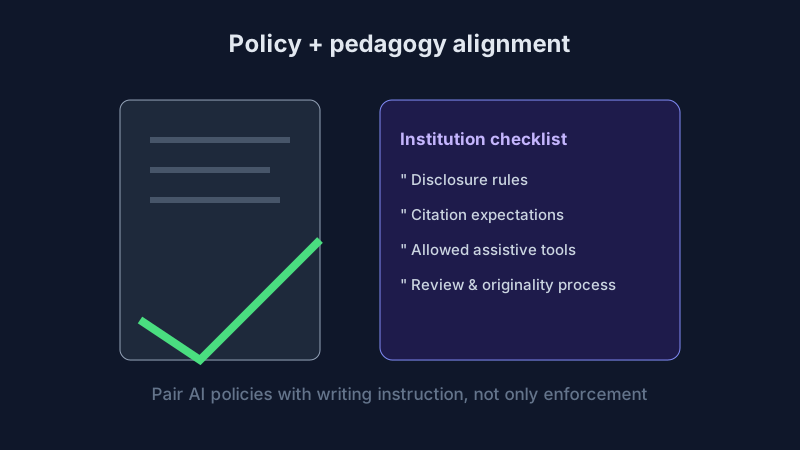
Frame policy as how to work professionally with new tools, not only as threats. Link to campus resources and examples of acceptable paraphrase + citation.
Appeals and false positives
Publish a clear appeals path when a detector flags ESL or polished human prose—opaque enforcement erodes trust faster than any tool error.
Related reading
How to detect AI-generated content and plagiarism checker guide.


Itamar Haim
SEO & GEO Lead, SynthQuery
Founder of SynthQuery and SEO/GEO lead. He helps teams ship content that reads well to humans and holds up under AI-assisted search and detection workflows.
He has led organic growth and content strategy engagements with companies including Elementor, Yotpo, and Imagen AI, combining technical SEO with editorial quality.
He writes SynthQuery's public guides on E-E-A-T, AI detection limits, and readability so editorial teams can align practice with how search and generative systems evaluate content.
Related Posts
Academic Integrity in the Age of AI: A Student's Guide
A supportive, practical guide for students: what universities usually allow, how to read your school’s AI policy, ethical use of tools for research and editing, what happens in misconduct cases, how to appeal a mistaken AI flag, disclosure language, and building real writing skills alongside AI.
AI Detection for Educators: A Complete Classroom Guide (2026)
A practical guide for high school and university instructors on using AI detection responsibly: statistics, pedagogy, interpreting scores, policy templates, assessment design, student conversations, FERPA-aware practice, and how tools compare—including SynthQuery workflows that scale.
Best AI Humanizers Compared: Undetectable.AI vs QuillBot vs SynthQuery (2026)
We humanized the same ten AI-generated paragraphs with seven leading tools, then scored outputs on readability, meaning preservation, and five major AI detectors. Here is a fair, criteria-based comparison for teams evaluating the best AI humanizer in 2026.
Get the best of SynthQuery
Tips on readability, AI detection, and content strategy. No spam.