How to Detect AI-Generated Content: Tools and Methods

- ai-detection
- writing
- tools
A practical guide to spotting AI-written text using detectors, linguistic cues, and the SynthRead tool for readability—plus limits, workflows, and what scores can and cannot prove.
AI-generated content is everywhere. From blog posts to product descriptions, writers and editors need reliable ways to tell human from machine. This guide walks you through tools, statistical intuitions, and editorial workflows—aligned with how we frame limits in ChatGPT detection: what tools can’t prove and how Google thinks about AI vs. human content.


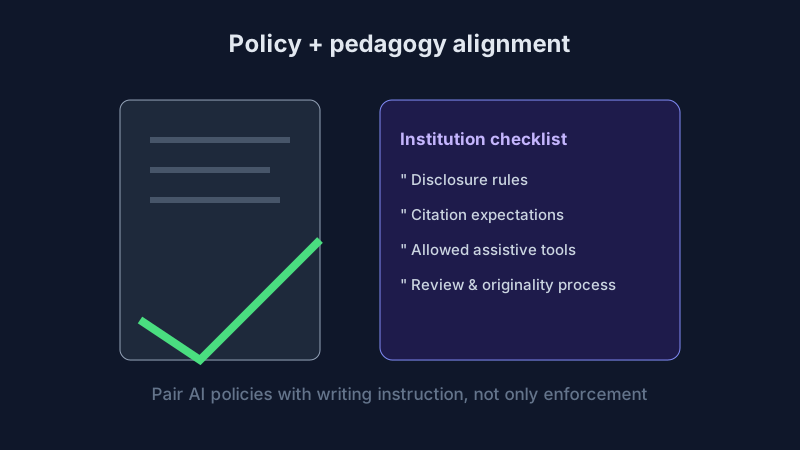
Table of contents
- Why does AI content detection matter (and what it is not)?
- How do modern detectors work (high level)?
- What should you check beyond the classifier score?
- A practical team workflow
- What patterns are common in AI-generated prose?
- Where do detectors fail?
- Balancing detectors with readability and human review
- Responsible use in schools and newsrooms
- References and related reading
Why does AI content detection matter (and what it is not)?
Detection matters when you need to protect academic integrity, meet publisher or brand rules, and give readers a reason to trust what they read. It is triage and quality control—not a single score that replaces human judgment.
Academic integrity and professional stakes
Publishers, educators, and brands care about authenticity. Readers trust human voices. Google’s public guidance emphasizes helpful, reliable, people-first content—see Creating helpful, reliable, people-first content—not a ban on automation by itself. Our overview of Google and AI-generated content explains why quality and disclosure matter more than which keyboard produced the draft. In academic or legal contexts, misattribution has real consequences. Learning to detect AI text helps you maintain quality and comply with policies. For emerging provenance ideas, watermarking and metadata are worth watching alongside classifier scores.
Research and product practice agree: no detector output is court-ready authorship proof. Treat scores as triage signals—useful for escalation, misleading when treated as verdicts.
Content marketing and reader trust
You can combine automated detectors with manual checks. Use a detector like our AI Detector for a first pass, then look for telltale patterns: uniform sentence length, generic transitions, and an overuse of certain phrases. The SynthRead tool also highlights readability and fluency issues that often accompany AI draft copy.
How do modern detectors work (high level)?
Most consumer-facing detectors are supervised classifiers or calibrated scoring models trained on corpora of human and machine text. Some incorporate statistical properties of token sequences (ideas related to perplexity and “burstiness” discussed in academic literature on generated text). The exact blend is proprietary, but the user-facing output is almost always a scalar or label with a non-zero error rate.
What “87% AI” usually means
When a tool reports a high AI probability, it typically means: given this text and our training data, this label has high confidence. It does not mean 87% of sentences were written by a named product, or that an institution would accept the number as evidence. Compare detectors on your drafts and record disagreements.
Why short samples and lists misbehave
Very short passages lack stable signal. Bullet lists, boilerplate, and templated support macros can look “AI-like” because they are structurally uniform. For more on these failure modes, read ChatGPT detection: what tools can’t prove.
What should you check beyond the classifier score?
The strongest setup combines classifier scores, linguistic heuristics, and human review—each catches different failure modes.
Classifier-based detectors
Classifier-based detectors feed text into a model trained on human vs. AI samples. They output a score or label. Accuracy depends on the training data and the type of AI (e.g., GPT-4, Claude, Gemini). Use them as one signal, not the only verdict.
Linguistic heuristics and style signals
Linguistic heuristics look at style: passive voice density, adverb placement, sentence variety, and vocabulary. These can be gamed but still catch low-effort AI output. Pair them with a detector for better results.
Human review for high-stakes content
Human review remains essential for high-stakes content. Have an editor scan for tone, fact-check claims, and ensure the piece matches your brand. No tool replaces a skilled human for final approval.
Process evidence beats a single score
When available, draft history, research notes, and interview logs beat any post-hoc score. The highest-signal question is often whether the author can show how the piece was produced.
A practical team workflow
Use a repeatable pipeline so writers know what “done” means and stakeholders can defend the process.
Before you paste text into any detector
Prefer 300+ words for stable scores. Freeze the version you scored; if three sentences change, re-run or note that the label applied to an earlier revision. Log URL, date, and tool version the same way you log SEO tests.
| Step | Action | What “good” looks like | | --- | --- | --- | | 1 | Paste draft into AI Detector | Scores treated as triage; long samples where possible | | 2 | Run SynthRead | Grade level matches audience; outliers visible | | 3 | Editor pass | Claims sourced; voice matches byline | | 4 | Policy check | Disclosure and permissions clear | | 5 | Appeals path | Human review if detector and editor disagree |
Policies, training, and disclosure
Set a policy: when AI is allowed, how it’s disclosed, and who approves it. Run important content through a detector and a readability pass. Train your team on what “AI-ish” writing looks like so they can flag it even without a tool.
Run detection and readability together
For important pages, run a detector and a readability pass in sequence. Catching stiff, uniform prose early saves rework before legal, brand, or SEO review.
What patterns are common in AI-generated prose?
Look for overly even rhythm, abstract actors, stock transitions, and “too clean” prose with few specifics—then verify with judgment, not pattern matching alone.
Surface traits to watch for
AI models often produce text with a few telltale traits. Sentence length tends to be very even; there are few short punchy sentences mixed with longer ones. Transitions like "Furthermore," "Moreover," and "In conclusion" appear often. The prose can feel smooth but generic, as if it could apply to any topic. Lists and bullet points are used heavily. Passive voice shows up more than in typical human writing. By contrast, human writing often has more variation, more personality, and occasional roughness or humor.
Building pattern recognition
Learning to spot these patterns takes practice. Run samples through a detector and then read the same samples yourself. Note where you agree or disagree with the score. Over time you’ll get faster at guessing which passages merit review even before you run a tool.
Mini example (fictional, for pattern recognition)
Passage A (generic): “Implementing a strong content review process is essential for organizations that wish to maintain trust with their audience. Furthermore, it is important to consider multiple stakeholders when designing this process. In conclusion, a holistic approach yields the best results.”
Passage B (specific): “When we rolled out reviewer training in Q3, support tickets about unclear articles fell 14% in six weeks—not perfect, but enough to keep the program funded.”
Passage A is not “proof” of AI; humans write that way under deadline. But Passage A shows even rhythm, abstract actors, and stacked transitions that editors and detectors often associate with default model tone. Passage B adds time-bound data and an imperfect outcome—harder for a model to invent plausibly without a source.
When to add plagiarism checks
If originality is contested, pair detection with a similarity check against the web and your corpus. See plagiarism checker guide. Detection asks whether text resembles typical LLM output; plagiarism asks whether it overlaps someone else’s words.
Where do detectors fail?
They misfire when formal or templated human writing looks “regular,” when bilingual writers use a polished register, or when heavy editing breaks the cues models were trained on.
False positives and formal registers
Carefully edited human text—legal, medical, or written by fluent non-native speakers—can resemble generated text in aggregate statistics. Apply domain judgment; never rely on a score alone for sanctions.
False negatives and heavy editing
Humans (or second-pass models) can inject variance enough to confuse classifiers. That is why “humanizer” tools are ethically double-edged; see AI humanizer guide.
Balancing detectors with readability and human review
Treat classifier output as one input: add readability signals for “flat” prose and escalate to another human when stakes or ambiguity are high.
Why detectors disagree—and what to add
No single tool is perfect. Detectors can be fooled by humanized or heavily edited text. They can also mislabel difficult or formal human writing as AI. So use detectors as one input. Add a readability check: AI draft copy often has a certain “flat” quality that shows up in readability metrics. Use the SynthRead tool to see sentence-level issues and grade level. If the text is bland and scores in a narrow band, that’s another signal to review it more closely.
When to escalate to a second human
Finally, when in doubt, ask a second human. Editors and peers can often sense when something doesn’t sound like the author. The best approach is always tool plus human judgment. For a full picture of detector behavior and false positives, read ChatGPT detection limitations.
Responsible use in schools and newsrooms
Education
Treat detectors as supporting evidence, not sole adjudicators of misconduct. False positives harm students; opaque appeals processes compound harm. Align with institutional AI guidance and emphasize pedagogy and process over punitive scoring.
Publishing
Newsrooms should pair detection with fact-checking, rights, and style workflows. Product teams should document when templates—not models—produce repetitive language so reviewers do not mistake policy macros for misconduct.
References and related reading
SynthQuery tools
- AI Detector — Sentence-level scoring and heatmaps for AI vs. human likelihood on your drafts.
- SynthRead — Readability and fluency signals that often surface next to AI-sounding prose.
On this blog
- ChatGPT detection: what tools can and can’t prove — Probabilistic scores, appeals, and responsible workflows.
- Does Google penalize AI content? — Quality, helpfulness, and E-E-A-T over “human only.”
- Watermarking AI text — Provenance, limits of watermarks, and defense in depth.
- How to humanize AI text — When detection flags style, editing paths that preserve meaning.
External references
- Google Search Central — Creating helpful, reliable, people-first content
- NIST — AI Risk Management Framework
- Mitchell et al., “Model Cards for Model Reporting,” ACM FAT 2019 — DOI 10.1145/3287560.3287596

Itamar Haim
SEO & GEO Lead, SynthQuery
Founder of SynthQuery and SEO/GEO lead. He helps teams ship content that reads well to humans and holds up under AI-assisted search and detection workflows.
He has led organic growth and content strategy engagements with companies including Elementor, Yotpo, and Imagen AI, combining technical SEO with editorial quality.
He writes SynthQuery's public guides on E-E-A-T, AI detection limits, and readability so editorial teams can align practice with how search and generative systems evaluate content.
Related Posts
What Is SynthID? Google's Multimodal AI Watermarking Explained
SynthID is Google DeepMind's watermarking and provenance technology for AI-generated images, audio, and video—not a generic 'AI detector.' Here's what it does, how it differs from statistical text checks, and what it means for publishers.
AI Content Detection in Journalism: How Newsrooms Verify Source Material
How journalism organizations use AI detection, wire-service policies, ethics codes, and workflows to protect trust—from breaking news to tips and comments—without treating classifiers as proof.
AI Detection API: How to Integrate AI Content Scanning Into Your Workflow
A developer-focused guide to integrating SynthQuery’s AI detection API: endpoints, auth, rate limits, Python/Node/cURL examples, WordPress and Google Docs patterns, batch jobs, score thresholds, and pricing-aware optimization.
Get the best of SynthQuery
Tips on readability, AI detection, and content strategy. No spam.