What Is SynthID? Google's Multimodal AI Watermarking Explained

- ai-detection
- watermarking
- provenance
- DeepMind
SynthID is Google DeepMind's watermarking and provenance technology for AI-generated images, audio, and video—not a generic 'AI detector.' Here's what it does, how it differs from statistical text checks, and what it means for publishers.
SynthID in one sentence
SynthID is a Google DeepMind technology for embedding and detecting watermarks in AI-generated content—especially images, audio, and video—so platforms can support provenance, labeling, and responsible use at scale. It is not the same thing as a general-purpose website that scores pasted text for “AI likelihood.”
Official overview and research links: SynthID on DeepMind.
Who built it and why it exists
Google DeepMind and product integration
DeepMind describes SynthID as part of a broader effort to make synthetic media identifiable and traceable where the generating system participates. That matters for trust, policy, and safety: if a model (or an app built on it) can mark output in a machine-detectable way, downstream tools can flag, filter, or label content consistently—when the watermark survives the path from generation to consumption.
Provenance, not “gotcha” scoring
The framing in public materials emphasizes scalable detection and deployment alongside other safeguards—not replacing human judgment or legal review. Think signal for platforms and pipelines, not a single number that “proves” authorship in every edge case.
What SynthID actually does
Multimodal watermarking
Unlike a paragraph of plain text that can be copied, translated, and edited in a thousand ways, pixels and waveforms still offer room to hide subtle statistical structure that specialized detectors can test for. SynthID extends watermarking-style ideas across modalities so that AI-assisted or AI-generated assets can carry a detectable imprint under controlled conditions.
Embed at generation, verify with the right stack
The usual mental model is:
- At generation time, the system (or a service using compatible APIs) embeds a watermark according to DeepMind’s approach.
- At verification time, a compatible detector or pipeline checks for that structure.
If the content never passed through a participating generator—or was heavily transformed—verification may be inconclusive or negative, even when humans suspect AI use.
SynthID vs. “AI detectors” for text
Different problem, different tools
Statistical AI text detection (perplexity-style signals, classifiers, style heuristics) tries to separate human-like vs. machine-like distributions in Unicode—often without access to the original model or a secret key. That is the family of tools discussed in how AI detectors work and ChatGPT detection limitations.
SynthID-class watermarking assumes cooperation from the generator (or an integrated product path). A random paste into a third-party box generally cannot “run SynthID” on arbitrary text the way a platform runs an internal verifier on known outputs.
Text is a hard domain
Our own stack documents that we do not perform key-based watermark detection such as SynthID on arbitrary uploads; text workflows differ from images and audio in how edits destroy signals. For a policy-level view of where watermarking fits, see watermarking AI text.
Limitations teams should plan for
Editing, export, and re-encoding
Cropping, recompression, heavy filters, paraphrase, and multi-tool pipelines can weaken or remove watermarks. No layer is tamper-proof; treat signals as probabilistic and combine with metadata (for example C2PA-style credentials where applicable), disclosure, and human review.
Mixed authorship
Human retouching on top of AI base layers, voice + music stems, or video with stock inserts breaks neat assumptions. Your playbook should say what to do when metadata and automated flags disagree—documentation and appeals matter as much as the algorithm.
What this means for content and compliance teams
Use the right tool for the question
- “Was this asset produced in a participating AI product in a way that retains SynthID?” → You need vendor-aligned verification paths, not a generic text paste.
- “Does this draft read like typical machine output for our risk workflow?” → Statistical detectors and editorial review—see AI Detector and how to detect AI content.
Stay standards-aware
Watermarking and content credentials will keep evolving. Build workflows that are tool-agnostic and human-centered, and revisit policies when platforms update generation and verification APIs.
SynthQuery note
SynthQuery focuses on transparent scoring for text (AI likelihood, readability, and related signals). That is complementary to platform-native watermarking like SynthID for media; it does not replace DeepMind’s proprietary verification for SynthID-marked assets.
Related reading
- How AI detectors actually work — Watermarking vs. classifiers vs. scoring LMs.
- Watermarking AI text — Publishers, metadata, and realistic limits.
- ChatGPT detection limitations — What scores can and cannot prove.
Authoritative sources
- Google DeepMind, SynthID — Product and research pointers.
- Kirchenbauer et al., A Watermark for Large Language Models — Foundational text watermarking paper (conceptually related; not identical to SynthID’s full multimodal stack).
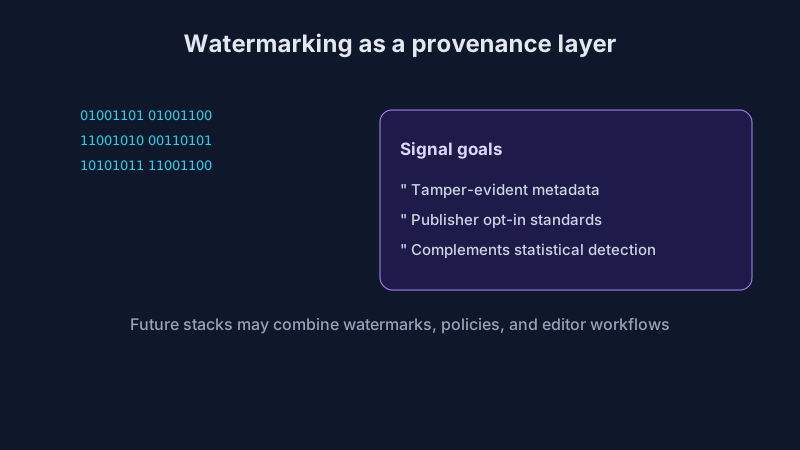

Practical takeaway
SynthID names a Google DeepMind program for watermarking and detecting AI-generated images, audio, and video when the creation path supports it. It answers a provenance question for participating systems—not “paste any paragraph and get a SynthID result.” For day-to-day text risk review, pair policy with AI Detector and SynthRead while media teams follow platform documentation for SynthID-compatible tools.
Related tools
- AI Detector — AI likelihood scoring for text drafts in current workflows.
- SynthRead — Readability and editing signals alongside detection.

Itamar Haim
SEO & GEO Lead, SynthQuery
Founder of SynthQuery and SEO/GEO lead. He helps teams ship content that reads well to humans and holds up under AI-assisted search and detection workflows.
He has led organic growth and content strategy engagements with companies including Elementor, Yotpo, and Imagen AI, combining technical SEO with editorial quality.
He writes SynthQuery's public guides on E-E-A-T, AI detection limits, and readability so editorial teams can align practice with how search and generative systems evaluate content.
Related Posts
How AI Detectors Actually Work: The Technology Behind the Scenes
A technical explainer of AI text detection: token probabilities, perplexity and burstiness, watermarks, classifiers, domain effects, multilingual limits, and why no score is ever mathematically certain.
AI Content Detection in Journalism: How Newsrooms Verify Source Material
How journalism organizations use AI detection, wire-service policies, ethics codes, and workflows to protect trust—from breaking news to tips and comments—without treating classifiers as proof.
AI Detection API: How to Integrate AI Content Scanning Into Your Workflow
A developer-focused guide to integrating SynthQuery’s AI detection API: endpoints, auth, rate limits, Python/Node/cURL examples, WordPress and Google Docs patterns, batch jobs, score thresholds, and pricing-aware optimization.
Get the best of SynthQuery
Tips on readability, AI detection, and content strategy. No spam.