Watermarking AI Text: What Publishers and Platforms Are Exploring

- AI
- watermark
- provenance
- policy
A non-hype overview of content credentials, statistical watermarks, metadata standards, and what teams should plan for while standards still diverge.
Why watermarking gets attention
Provenance and regulatory pressure
Regulators and platforms want provenance for synthetic media and text. Approaches include metadata (C2PA-style credentials), model-side statistical watermarks, and social norms (labeling, disclosure).
Three layers teams talk about
Metadata proves origin when intact; statistical watermarks embed signals in model output; social norms cover disclosure and labeling. Most serious programs combine more than one.
Why text is harder than images
Plain text passes through paste buffers, translation, and heavy editing more often than fixed media—any watermark must survive realistic workflows, not lab-only conditions.
Limits of watermarking
Stripping, editing, and paraphrase
Watermarks can be stripped, cropped, or paraphrased away. Statistical signals weaken after rewrite. No single layer is sufficient; defense in depth matters.
Mixed authorship and tool chains
Human edits, multiple models, and aggregator tools can break assumptions a watermark was tested on—treat provenance as probabilistic, like detector scores.
Divergent standards
Vendors and regulators have not converged on one metadata format—plan for tool-agnostic review while credentials evolve.
What teams should do now
Policy, review, and training
Document AI use in your CMS, keep human review for risky claims, and train staff on deepfake and voice clone risks—not only text. Pair policy with AI Detector scoring where appropriate, alongside the workflows in how to detect AI content.
Disclosure and audience expectations
Align public disclosure with what readers and regulators expect—even perfect metadata does not replace transparent publishing practices.
Appeals when signals conflict
Define how you resolve metadata vs. an editor’s knowledge of how a piece was produced—documentation and appeals beat a single automated flag.
SynthQuery view
Transparent scoring and readability
We invest in transparent scoring and readability because trust is multidimensional. Watch this space as industry standards converge—your workflows should stay tool-agnostic and human-centered.
Operational stack today
Until watermark adoption is universal, AI Detector plus human review remain the practical layer most teams can deploy this quarter.
Related reading
ChatGPT detection limitations and Google and AI content.
Authoritative sources
The C2PA standard describes content credentials for provenance. NIST’s AI Risk Management Framework is a common reference for organizational AI governance. For technical background on watermarking language-model output, see research such as A Watermark for Large Language Models.
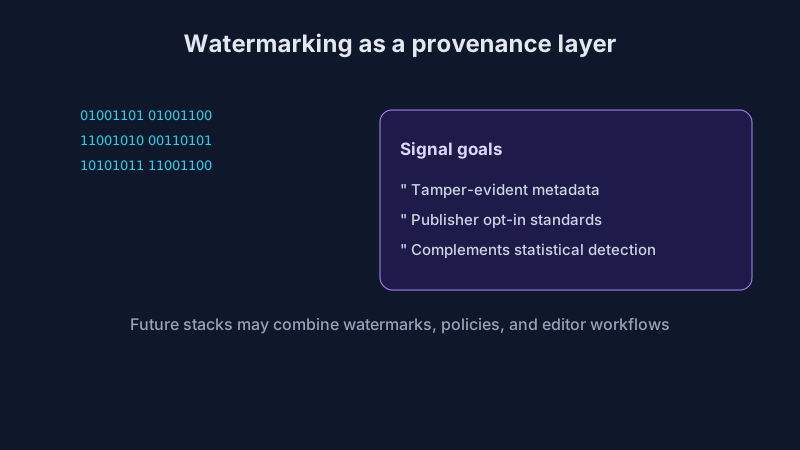

Classifiers, watermarks, and your stack today
Watermarks and metadata may mature on different timelines than your CMS release cycle. Until standards converge, teams still rely on AI Detector scoring and clear editorial policy. Pair that with the workflow in how to detect AI content: detectors flag risk; humans decide; documentation beats a single number.
When watermark claims conflict with reader experience—rewrites, translation, mixed authorship—fall back to the same cautions in ChatGPT detection limitations. For search-facing publishing, Google and AI-generated content remains the bar: helpful, original, people-first.
Related Tools
- AI Detector — Current-state AI likelihood scoring while provenance standards evolve.
- SynthRead — Readability and transparency in the draft readers actually see.
Related Articles
- How to detect AI-generated content — Methods and manual checks alongside tools.
- ChatGPT detection limitations — What scores can and cannot prove.
- Does Google penalize AI content? — Quality signals vs. authorship labels.
- AI humanizer guide — Editing approaches when style, not provenance, is the issue.

Itamar Haim
SEO & GEO Lead, SynthQuery
Founder of SynthQuery and SEO/GEO lead. He helps teams ship content that reads well to humans and holds up under AI-assisted search and detection workflows.
He has led organic growth and content strategy engagements with companies including Elementor, Yotpo, and Imagen AI, combining technical SEO with editorial quality.
He writes SynthQuery's public guides on E-E-A-T, AI detection limits, and readability so editorial teams can align practice with how search and generative systems evaluate content.
Related Posts
What Is SynthID? Google's Multimodal AI Watermarking Explained
SynthID is Google DeepMind's watermarking and provenance technology for AI-generated images, audio, and video—not a generic 'AI detector.' Here's what it does, how it differs from statistical text checks, and what it means for publishers.
AI Content Detection in Journalism: How Newsrooms Verify Source Material
How journalism organizations use AI detection, wire-service policies, ethics codes, and workflows to protect trust—from breaking news to tips and comments—without treating classifiers as proof.
AI Detection API: How to Integrate AI Content Scanning Into Your Workflow
A developer-focused guide to integrating SynthQuery’s AI detection API: endpoints, auth, rate limits, Python/Node/cURL examples, WordPress and Google Docs patterns, batch jobs, score thresholds, and pricing-aware optimization.
Get the best of SynthQuery
Tips on readability, AI detection, and content strategy. No spam.