Voice and Tone Guides: Build One Your Team Will Actually Use

- brand voice
- content ops
- editorial
- style guide
What belongs in a modern voice guide, how tone shifts by channel, reusable patterns for AI-assisted drafting, and how to keep guidance short enough to ship.
Voice, tone, and the minimum guide
Voice vs. tone
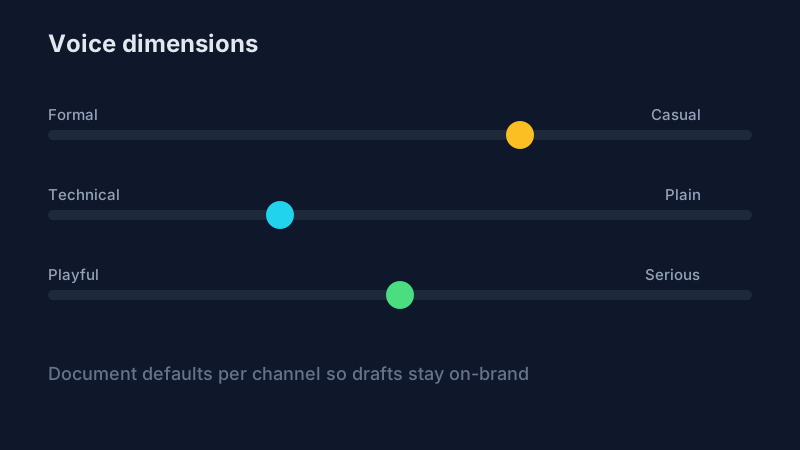
Voice is stable personality (direct, curious, calm). Tone flexes by situation (apologetic outage post vs. celebratory launch). Put voice principles on one page; put tone matrices (channel × scenario) on another.
Minimum viable guide
(1) Audience and jobs-to-be-done. (2) We say / we don’t say with real snippets from your product. (3) Formatting rules (dates, numbers, capitalization). (4) Inclusive language pointers. (5) Legal/compliance non-negotiables with examples. (6) Internal links from each surface to pillar pages—see internal linking for topical authority.
Channel and scenario matrix
Add a compact channel × scenario grid: marketing site vs. in-product vs. email vs. support—same voice, different formality and risk defaults so teams don’t paste blog tone into error strings.
Making guides usable
Make it scannable
Long PDFs die in Slack threads. Prefer searchable docs with anchors. Link to your grammar checker, Humanizer when drafts sound stiff or generic, and readability tool expectations: e.g. “Help docs target grade 9–11 in SynthRead.”
AI workflows
Give writers approved prompts that include voice bullets. Require a human pass for claims, humor, and regulated statements—after machine passes on Grammar and, when needed, Humanizer. Log exceptions when legal overrides marketing.
Onboarding and templates
Link the guide from CMS templates and new-hire writing tasks so “check voice” is a step in the workflow, not a buried PDF.
Governance and longevity
Ownership and changelog
Name an owner, a review cadence, and a changelog. Celebrate teams who submit improvements—guides stay alive through contributions, not decrees.
Deprecation and retired phrasing
When product names or legal disclaimers change, strike old examples explicitly—stale “we say” snippets teach the wrong habits.
Quarterly spotchecks
Sample shipped copy (blog, UX, email) against the guide each quarter; track drift before it needs a full rewrite.
Related reading

Tools in the loop
Correctness before voice polish
Grammar catches errors and awkward agreement before brand review—run it on anything that will ship.
Cadence and “AI-shaped” drafts
Humanizer helps when drafts sound stiff or generic after a first AI pass; pair with a human edit for claims and humor.
Readability targets by surface
SynthRead holds grade bands and sentence fixes. Align targets with writing for grade 8 for broad surfaces, and point content strategists to the SaaS blog outline template so outlines already encode internal links and readability budget.
Related Tools
- Grammar — Errors and awkward phrasing before brand review.
- Humanizer — Softer, more natural phrasing when drafts read robotic.
- SynthRead — Readability metrics tied to your stated voice bands.
Related Articles
- Jargon vs. precision in B2B — Technical terms vs. clarity.
- Email newsletter readability — Voice in tight formats.
- SaaS blog outline template — Intent, structure, and links at outline time.
- Clichés in business writing — Phrases to ban from your guide.

Itamar Haim
SEO & GEO Lead, SynthQuery
Founder of SynthQuery and SEO/GEO lead. He helps teams ship content that reads well to humans and holds up under AI-assisted search and detection workflows.
He has led organic growth and content strategy engagements with companies including Elementor, Yotpo, and Imagen AI, combining technical SEO with editorial quality.
He writes SynthQuery's public guides on E-E-A-T, AI detection limits, and readability so editorial teams can align practice with how search and generative systems evaluate content.
Related Posts
Academic Integrity in the Age of AI: A Student's Guide
A supportive, practical guide for students: what universities usually allow, how to read your school’s AI policy, ethical use of tools for research and editing, what happens in misconduct cases, how to appeal a mistaken AI flag, disclosure language, and building real writing skills alongside AI.
AI Detection for Educators: A Complete Classroom Guide (2026)
A practical guide for high school and university instructors on using AI detection responsibly: statistics, pedagogy, interpreting scores, policy templates, assessment design, student conversations, FERPA-aware practice, and how tools compare—including SynthQuery workflows that scale.
Best AI Humanizers Compared: Undetectable.AI vs QuillBot vs SynthQuery (2026)
We humanized the same ten AI-generated paragraphs with seven leading tools, then scored outputs on readability, meaning preservation, and five major AI detectors. Here is a fair, criteria-based comparison for teams evaluating the best AI humanizer in 2026.
Get the best of SynthQuery
Tips on readability, AI detection, and content strategy. No spam.