AI Humanizer Guide: How They Work and Best Practices

- humanizer
- ai
- writing
How AI humanizers rewrite machine-sounding text, what bypass scores mean, ethical guardrails, and workflows that pair humanization with detection and SynthRead.
AI humanizers take text that sounds machine-written and rewrite it to sound more natural. Teams use them to improve fluency, tighten voice, or reduce classifier flags—but the output is still machine-generated unless a human fully replaces it. This guide explains mechanics, bypass scores, ethics, and how to pair tools with AI detection and SynthRead.

What humanizers do
Rewriting for natural rhythm
A humanizer is typically an AI model (e.g., GPT-4) given instructions to preserve meaning while changing style. It might vary sentence length, reduce passive voice, swap generic phrases for more specific ones, and add a bit of imperfection. The goal is output that still reads well but doesn't trigger "this was written by a bot" in readers or in AI detectors.
Quality varies—always review
Not all humanizers are equal. Some only paraphrase; others are tuned for bypassing detectors. Quality varies with the prompt, the model, and the source text. Always review the result. Use a detector and a readability tool to see if the humanized version actually scores better and reads more naturally.
What is a bypass score?
How detectors score humanized output
When you run a humanizer, many tools (including SynthQuery Humanizer) run the output through an AI detector. The bypass score is often framed as the detector’s residual belief that the text is AI-generated. Lower values usually mean “more human-like under that detector’s training.” If the score is below a threshold (e.g. 0.3 or 30%), the UI may label the result as “passes detection.”
Why the number isn’t a guarantee
Use this as a signal, not a guarantee—detectors vary by vendor and model generation, and a single number can't capture every reader's impression. Combine it with readability and your own edit. For limits of probabilistic scores, read ChatGPT detection: what tools can’t prove.
When to use them
Marketing, support, and internal comms
Humanizers can help when you have a solid AI draft that feels too stiff or uniform. They're useful for marketing copy, support replies, or internal docs where tone matters. They're not a substitute for fact-checking or for having a clear content policy. Use them to polish, not to hide the use of AI where disclosure is required.
A simple end-to-end workflow
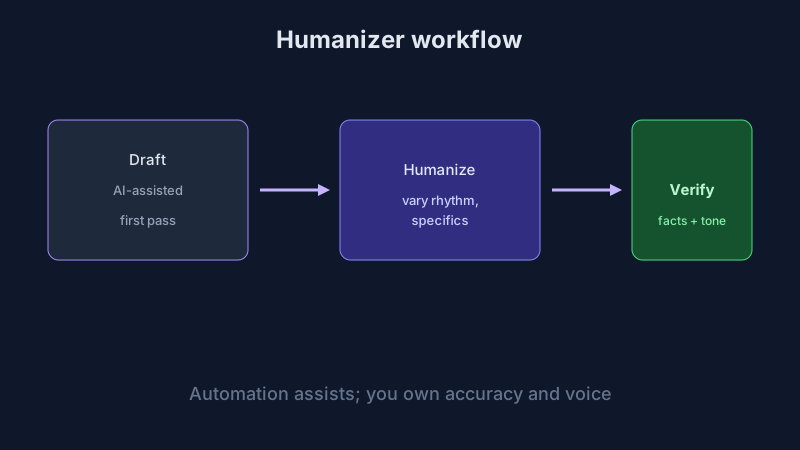
Best practice: draft with AI if your policy allows it, run a humanizer if you want a more natural tone, then edit and approve with a human. Check readability and detection scores before and after so you know the humanizer actually improved things.
Three-layer review (meaning, style, signals)
| Layer | Question | Tooling | | --- | --- | --- | | Meaning | Are facts, numbers, and names intact? | Human editor + sources | | Style | Does this match brand voice? | Humanizer + manual pass | | Signals | Is prose readable; does detection still flag? | SynthRead, AI Detector |
Run SynthRead after humanization because models sometimes trade polysyllables for shorter words unevenly—grade level can drift even when tone improves.
Limits and ethics
Integrity and disclosure
Humanizers can be misused to evade academic or professional integrity rules. Our view: use them to improve clarity and engagement, not to deceive. Disclose AI use where your organization or platform requires it.
Pair with human review and readability tools
Combine humanizers with human review and with tools like SynthRead to keep quality and authenticity high.
How humanizers are built
LLMs, prompts, and fine-tuning
Most humanizers are built on top of large language models. You send in text and a system prompt that says something like: "Rewrite this to sound more natural and human while keeping the same meaning. Vary sentence length, reduce passive voice, and avoid generic phrases." The model then generates a new version. Some services fine-tune on human-edited pairs (AI input, human output) to get a style that passes detectors more often.
When humanization struggles
The quality of the output depends on the model, the prompt, and the source text. Very technical or niche content may not humanize well. Very short text may not have enough to work with. Experiment with a few paragraphs first and compare before/after with a detector and a readability check.
Picking a humanizer
Features to compare
Look for a service that lets you control tone (e.g., professional vs. casual) and that doesn't strip important details. Check whether it supports your language and length.
Run a side-by-side test
Run a test: paste the same AI draft into two humanizers and compare readability and detection scores. The one that gives you more natural, detector-resistant output without losing meaning is the better fit for your workflow.
Tips for better results
Mode, readability, and voice
- Choose the right mode. Use academic for papers, casual for blogs, professional for business copy. Matching the mode to the context improves consistency.
- Set a readability target. If your audience reads at a certain grade level, ask the humanizer to aim for it so the output isn't too simple or too dense.
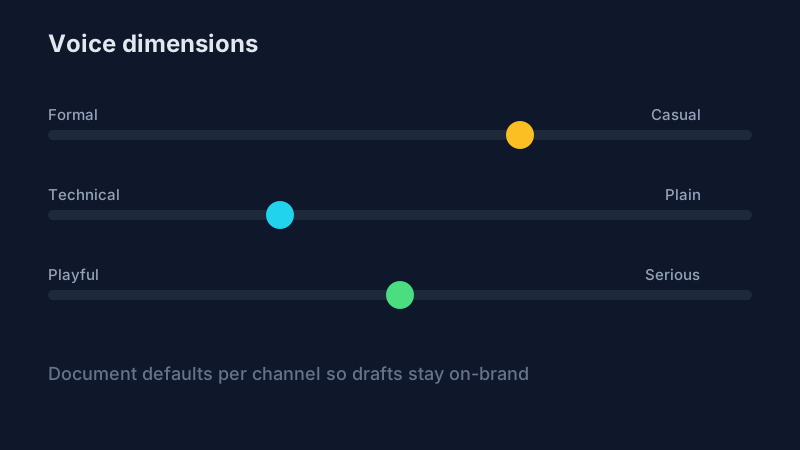
- Provide a brand voice sample. When you have existing copy that sounds right, paste a short sample so the humanizer can match tone and style.
- Use "light" for small tweaks. If you only want subtle changes, pick a light or conservative setting so the humanizer doesn't overwrite your voice.
- Iterate. Run the humanizer, then use "use as input" and run again with different settings if the first pass isn't quite right.
Conservative vs aggressive passes
Match the strength of the humanizer to the draft: use light settings for already-good copy, stronger modes when the text is obviously uniform or detector-prone.
Iterate instead of accepting the first draft
If the first pass feels flat, tweak settings or run a second pass on selected paragraphs—small iterations often beat one aggressive rewrite.
Reproducibility, languages, and fairness
Model version and randomness
Humanizers are non-deterministic unless the product pins model version and temperature. If compliance needs reproducibility, record model name, date, prompt preset, and input hash. Expect small score drift between runs—that is normal LLM behavior.
Multilingual and localization
Humanizers trained primarily on English may flatten idioms in other languages—producing grammatically fine but culturally off copy. Have a native editor review localized outputs. For translation-heavy workflows, see translating content for readability.
Fairness and bias
Style transfer can inadvertently erase dialect, voice, or culturally specific framing in pursuit of “neutral” prose. If your brand celebrates a distinctive voice, use light modes and preserve quoted material verbatim.
What humanizers cannot fix
Facts and citations
If the draft asserts numbers or sources that were never verified, humanization only polishes the mistake. Run your normal fact-check pipeline first—especially for YMYL topics tied to E-E-A-T.
Brand voice without examples
“Sound like us” fails when the model has no positive examples. Provide a short approved snippet or banned-phrases list—see cringe AI phrases to edit.
Regulated and legal language
Contracts and safety warnings often require exact phrasing. Do not humanize unless counsel approves a controlled glossary.
Enterprise policy starter (adapt with legal)
- Allowed use cases — e.g., marketing drafts vs. prohibited for graded student work.
- Disclosure rules — customer-facing vs. academic contexts.
- Retention — whether inputs/outputs are logged.
- Appeals — what happens if a detector flags human-edited work (limitations).
- Review gates — two-person review for high-risk pages.
Measuring success without gaming detectors
Track time-to-publish, edit rounds, and support tickets—not only bypass scores. If humanization speeds drafts but increases refunds on product copy, the classifier number is the wrong KPI.
Accessibility: after humanization, re-check headings and lists; models sometimes collapse structured blocks into long paragraphs.
Institutions increasingly publish AI literacy guidance for students and staff—pair internal policy with those frameworks rather than detector scores alone.
For a full detection workflow (beyond bypass numbers), see how to detect AI-generated content. Compare Flesch–Kincaid before and after if you need a numeric readability baseline. One pass rarely fixes both tone and depth.
FAQ
Does humanizing count as AI use?
Yes. The output is still generated by an AI model. Disclose according to your rules.
Can detectors always tell?
No. Detectors improve over time, but humanizers do too. Use bypass scores as one signal among many.
Humanize vs paraphrase
Paraphrase focuses on different wording; humanize focuses on naturalness, rhythm, and reducing AI-typical patterns. They can overlap.
Should I humanize everything?
No. Use it where tone and naturalness matter and where you're allowed to use AI. Don't use it to evade policies that require original or human-only work.
Try the SynthQuery Humanizer with multiple modes, readability targets, and an optional brand voice sample—then compare original vs. humanized with the built-in diff and bypass score.

Itamar Haim
SEO & GEO Lead, SynthQuery
Founder of SynthQuery and SEO/GEO lead. He helps teams ship content that reads well to humans and holds up under AI-assisted search and detection workflows.
He has led organic growth and content strategy engagements with companies including Elementor, Yotpo, and Imagen AI, combining technical SEO with editorial quality.
He writes SynthQuery's public guides on E-E-A-T, AI detection limits, and readability so editorial teams can align practice with how search and generative systems evaluate content.
Related Posts
How to Make AI-Generated Content Sound Human (Without a Humanizer Tool)
Manual editing techniques to make AI drafts feel natural: voice, rhythm, specifics, and a repeatable workflow—plus prompt templates and a checklist so you can pass the human test before you publish.
The Ethics of AI Humanizers: Should You Use Them?
A balanced look at AI humanizer ethics: who benefits, what breaks down when tools hide authorship, and a practical framework—transparency, value-add, context, and harm—for deciding when use is defensible.
What Is an AI Humanizer? How Text Humanization Technology Works
A deep explainer on AI humanizers: what they change in text, how techniques differ, ethics, and how SynthQuery approaches humanization.
Get the best of SynthQuery
Tips on readability, AI detection, and content strategy. No spam.