Self-Plagiarism: What It Is, Why It Matters, and How to Avoid It

- self-plagiarism
- originality
- academic writing
- ethics
- content strategy
Self-plagiarism means reusing your own published or submitted work without clear disclosure—often misunderstood, sometimes a policy violation, and separate from copyright. Here is a practical guide to contexts, checkers, rights, and ethical repurposing.
What self-plagiarism actually means
A plain definition
Self-plagiarism (sometimes called duplicate publication or text recycling) is the practice of reusing substantial portions of your own previously published or submitted work—wording, structure, data presentation, or arguments—without telling readers or rights-holders that the material appeared before. It is not “stealing ideas from a stranger.” It is recycling your own output in a context where originality, transparency, or contractual obligations require disclosure.
That distinction matters: many people assume that if they wrote it, they can reuse it anywhere. In academia, journalism, legal filings, and client contracts, that assumption is often wrong. In marketing and social, the same act can be normal—as long as you are not breaching an assignment agreement or misleading an audience about what is new.
How it differs from copyright infringement
You can commit a self-plagiarism violation under a policy while still owning the copyright, or you can infringe someone else’s rights (including a publisher’s) even when the words are yours. The next sections unpack policy (integrity rules) and law (who holds rights to the work product).
Why self-plagiarism is treated as a problem
In academia and research
Peer-reviewed publishing depends on clear contribution: readers need to know what is genuinely new in a paper versus what repeats earlier work. Recycling methods, discussion paragraphs, or results across outlets without cross-reference can inflate apparent novelty, distort the literature, and break journal guidelines on prior publication. That is why duplicate submission—sending the same manuscript to two venues—is a serious offense even when you are the author of both copies.
Editors also watch for salami slicing (splitting one study into minimal publishable units to pad a CV) and for overlapping authorship where recycled paragraphs make independent articles look more distinct than they are. Responsible reuse—such as a methods paragraph that genuinely matches a prior protocol—typically comes with citation, permission where required, and editorial transparency, not with silent copy-paste.
In journalism and media
News organizations care about original reporting, timeliness, and disclosure. Republishing a column or investigation without labeling it as previously published can mislead subscribers and advertisers. Syndication is fine when labeled and contractually permitted; silent recycling is not the same thing.
Wire services, partner desks, and republish buttons exist precisely because distribution is licensed—but bylines, datelines, and editor’s notes exist so audiences understand what they are reading. If you freelance for multiple outlets, avoid pitching nearly identical stories without telling editors; competing publications may treat that as a breach of trust even when copyright remains with you.
In professional and client contexts
If you sold exclusive rights or produced work for hire, the client or publisher may control reuse. Turning in “new” deliverables that are lightly edited versions of another client’s project can violate contract, confidentiality, or professional ethics—even when no third-party plagiarism checker flags “someone else’s” text.
When self-plagiarism usually matters
Peer-reviewed journals and conferences
Expect strict rules: cite your own prior papers, declare overlapping material in cover letters, and follow COPE-style expectations on redundant publication. Some venues allow responsible text recycling in methods sections; others do not. Always read the author guidelines.
Coursework and assessments
Submitting the same essay to two classes, or resubmitting your own past paper without permission, is typically academic misconduct. Instructors grade this term’s learning; undisclosed reuse defeats that purpose.
Theses, grants, and regulatory filings
Duplicating text across a thesis chapter and a journal article can be acceptable with explicit sign-off and proper citation—but not when policies require distinct documents or when the overlap hides prior dissemination of results.
Client work and ghostwriting
If the contract says original deliverables, recycling large blocks from another engagement is a breach, even when similarity software shows only “your” text.
When it often does not matter (the same way)
Owned channels and marketing
Repurposing a blog post into a newsletter, LinkedIn carousel, and webinar outline is standard content strategy—provided you control the rights, do not imply a piece is “exclusive” when it is not, and comply with platform rules. The issue is rarely “self-plagiarism” in the academic sense; it is honesty, rights, and fatigue (readers seeing the same hook five times).
Teams often maintain a content matrix: one research interview becomes a case study, a podcast episode, and three social clips. That is smart reuse when each format adds new framing or new audience value—not when every channel gets the same 800 words with a different headline.
Social media
Short-form reuse of your own lines across platforms is normal. Problems appear when platform or employer policies forbid it, or when recycled posts misrepresent timing (e.g., presenting old news as breaking).
Internal documentation
Reusing your own templates, SOPs, and help-article skeletons inside a company is usually expected. Still avoid carrying confidential details from one client folder to another.
Copyright: can you plagiarize yourself if you sold the rights?
Authorship versus ownership
You may still be the named author after publication, but copyright can belong to a publisher, employer (work for hire), or client, depending on contract and jurisdiction. If you assigned exclusive rights, reprinting the same article on your blog without permission can be copyright infringement—even though it is “your” writing in everyday speech.
Non-exclusive and open licenses
Preprints, Creative Commons, or retained author rights can allow broad reuse if you follow the license (attribution, non-commercial limits, etc.). “I wrote it” is not a substitute for reading what you signed.
Practical takeaway
Before large-scale reuse, check: Who owns the copyright? What does the contract allow? If unsure, ask the rights-holder or legal counsel—especially for books, stock photo-like asset sales, and enterprise content.
Myths that cause mistakes
“I’m only quoting myself” can still violate publisher policy if the overlap is undisclosed or duplicates a prior exclusive license. “It’s on my personal site” does not automatically override a journal’s prior rights. “I changed every third word” is not a substitute for honest attribution when the substance is the same—and it can still fail integrity rules if the work was meant to be original.
How plagiarism checkers handle self-plagiarism
Similarity is not a verdict
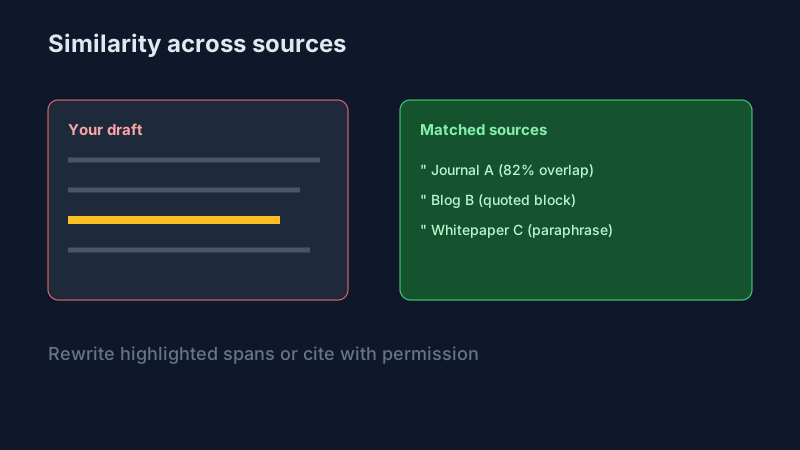
Tools compare text to corpora: web, licensed databases, and sometimes institutional submission repositories. A match to your own earlier paper appears as overlap, not as “self-plagiarism” in a moral sense. The policy (school, journal, client) decides whether that overlap is allowed.
Some products let you exclude bibliographic entries or quoted material; few can infer permission or self-citation. A high “similarity” score to your dissertation chapter is expected if you are turning a chapter into an article—if editors approved the plan. The same score is a red flag if you implied the article was entirely fresh.
Student systems and prior submissions
Many universities store past work. Resubmitting your own essay can match itself or match a classmate if templates align—another reason disclosure matters.
What to do when you match yourself
Treat alerts as triage: cite the prior work, remove duplicated methods if redundant, paraphrase where recycling is unnecessary, or obtain permission where required. For a repeatable workflow across drafts, pair similarity review with readability and structure passes using SynthRead and run institutional or client-approved checks with our plagiarism tool—see also our plagiarism checker guide.
Strategies for legitimately repurposing your own content
Start with rights and rules
Read contracts, journal policies, and course syllabi before reusing. When in doubt, disclose and ask.
Cite yourself openly
In scholarly writing, self-citation is the norm for prior results. In marketing, label repurposed pieces (“Originally published…” / “Adapted from…”) when transparency helps the audience.
Rebuild instead of copy-paste
For new contexts, change structure, update examples, add data, and trim what does not serve the reader. Legitimate reuse adds value; lazy duplication does not.
Version control and source notes
Keep draft history and a single source of truth for facts (dates, statistics, product names) so recycled content does not drift into inaccuracy.
When you localize or translate prior work, log which locale was the source of truth for compliance claims—regulatory and stats differ by market, and “self-reuse” can accidentally spread wrong numbers faster than new drafts.
Separate confidential from public
Maintain clean-room habits: never migrate sensitive details from one client context to another in reused templates.
Flowchart: Is this self-plagiarism?
Use this as a quick screen, not legal advice. When stakes are high, verify against written policies and contracts.
                    ┌──────────────────────────────┐
                    │ Are you reusing substantial  │
                    │ text or data from YOUR past  │
                    │ work?                        │
                    └──────────────┬───────────────┘
                                   │
                          NO ──────┴────── YES
                           │                 │
                           ▼                 ▼
                    ┌────────────┐    ┌──────────────────────┐
                    │ Not self-  │    │ Will readers /       │
                    │ plagiarism │    │ reviewers assume     │
                    │ (other     │    │ this deliverable is  │
                    │ issues may │    │ NEW or ORIGINAL to   │
                    │ still      │    │ this context?        │
                    │ apply)     │    └──────────┬───────────┘
                    └────────────┘               │
                                      YES ─────┴───── NO
                                       │              │
                                       ▼              ▼
                            ┌────────────────┐  ┌─────────────┐
                            │ Are you clearly│  │ Often lower   │
                            │ DISCLOSING and │  │ risk IF rights│
                            │ CITING prior   │  │ and platform  │
                            │ work per policy│  │ rules allow   │
                            │ and contract?  │  │ reuse         │
                            └───────┬────────┘  └───────┬───────┘
                                    │                   │
                         YES ───────┴────── NO           │
                          │              │              │
                          ▼              ▼              ▼
                   ┌───────────┐  ┌──────────────────────────┐
                   │ Generally │  │ RISK: policy / ethics / │
                   │ OK if     │  │ contract violation        │
                   │ policy    │  │ (often called self-       │
                   │ agrees    │  │ plagiarism or duplicate   │
                   └───────────┘  │ publication)              │
                                  └──────────────────────────┘
Self-plagiarism policies by industry (summary)
Policies vary by institution—always read your own handbook or contract. This table is a high-level comparison.
| Industry / context | Typical stance on reuse | What usually saves you | |----------------------|-------------------------|-------------------------| | Higher education (coursework) | Submitting the same work twice without permission is prohibited | Instructor approval; new original work for each assessment | | Peer-reviewed journals | Duplicate publication and undisclosed overlap are serious | Cross-citation, disclosure to editors, permissions where needed | | Grant agencies / funders | Misrepresentation of prior work or double-dipping is risky | Clear reporting of overlaps; institutional sign-off | | Newsrooms | Undisclosed recycling erodes trust | Labeling; syndication deals; transparency with editors | | Marketing & owned media | Reuse is common; misleading reuse is the problem | Rights control; clear labeling when freshness matters | | Client services (agency, freelance) | Contracts often require original deliverables | New work product; explicit client approval for adaptation | | Government / legal filings | Accuracy and filing rules dominate; boilerplate may repeat | Jurisdiction-specific rules; never recycle confidential facts |
Tips for ethical content repurposing
- Disclose when reuse affects how readers judge novelty—especially in scholarship and news.
- Ask permission before resubmitting student work, client work, or publisher-owned content.
- Cite prior papers and versions when academic or professional norms expect it.
- Update statistics, screenshots, and examples so recycled content stays true.
- Segment audiences: a deep guide can become a checklist, a talk, and a thread—add new angles each time.
- Track versions in Git, a CMS, or a doc system so you do not accidentally ship stale claims.
- Run similarity checks where policy requires them, and interpret results with human judgment—tools do not replace context (plagiarism checker guide).
- Align your team on a repurposing playbook: who approves cross-posts, how syndicated pieces get labeled, and where canonical URLs live so search engines and readers see a clear primary version.
Self-plagiarism is less about “can I reuse my words?” and more about which promises you made to readers, institutions, and clients—and whether your reuse respects those promises.
Related reading
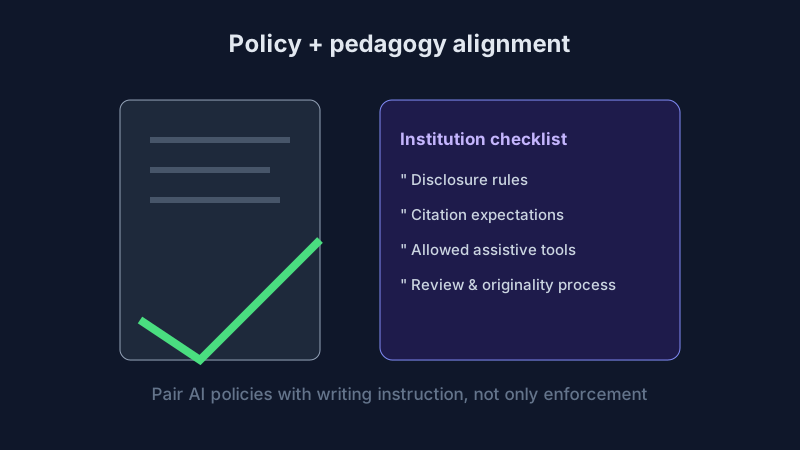
For overlapping themes on integrity, AI disclosure, and originality workflows, see academic integrity and AI policies and our AI humanizer guide—useful when you are rewriting with transparency rather than recycling without credit.

Itamar Haim
SEO & GEO Lead, SynthQuery
Founder of SynthQuery and SEO/GEO lead. He helps teams ship content that reads well to humans and holds up under AI-assisted search and detection workflows.
He has led organic growth and content strategy engagements with companies including Elementor, Yotpo, and Imagen AI, combining technical SEO with editorial quality.
He writes SynthQuery's public guides on E-E-A-T, AI detection limits, and readability so editorial teams can align practice with how search and generative systems evaluate content.
Related Posts
Plagiarism Checkers: A Practical Guide for Students, Freelancers, and Teams
How similarity detection works, what “plagiarism” means in tools vs. policy, citation edge cases, and a workflow that protects both originality and collaboration.
Academic Integrity in the Age of AI: A Student's Guide
A supportive, practical guide for students: what universities usually allow, how to read your school’s AI policy, ethical use of tools for research and editing, what happens in misconduct cases, how to appeal a mistaken AI flag, disclosure language, and building real writing skills alongside AI.
Citation Styles Explained: APA, MLA, Chicago, Harvard (2026 Guide)
A practical 2026 reference for APA 7th, MLA 9th, Chicago 17th, and Harvard-style author–date citations: who uses each system, in-text and reference formats, books, journals, websites, and AI-generated content—with comparison tables, cheat sheets, and common mistakes.
Get the best of SynthQuery
Tips on readability, AI detection, and content strategy. No spam.