How to Write for a Grade 8 Reading Level (And Why You Should)

- readability
- grade-8
- writing
- plain language
- seo
A practical guide to writing for a grade 8 reading level—the common standard for web content. Learn why it matters, how literacy and research back it up, techniques that work, mistakes to avoid, tools to measure level, and five before-and-after rewrites.
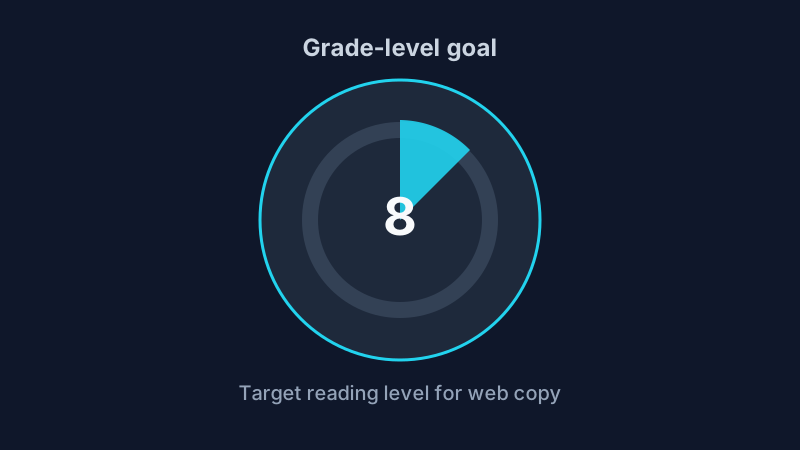
When content strategists say you should write for a grade 8 reading level, they are not asking you to sound childish. They are asking you to match how most adults actually read on the web: quickly, often on a phone, with limited patience for dense syntax and rare words. This guide shows how to write for a grade 8 reading level in practice—sentence length, word choice, structure, and voice—plus when to aim higher or lower, common mistakes that inflate scores, tools that measure reading level, and before/after examples you can copy.
Why grade 8 is the standard for web content
What “grade 8” actually measures
“Grade level” in tools like Flesch–Kincaid is a statistical shorthand: it combines average sentence length and syllables per word (and sometimes other factors in other formulas) to approximate the years of U.S. schooling needed to read a passage comfortably. It does not measure intelligence, topic difficulty, or whether your facts are right. Two pages on quantum computing can score differently based only on how you phrase the explanation.
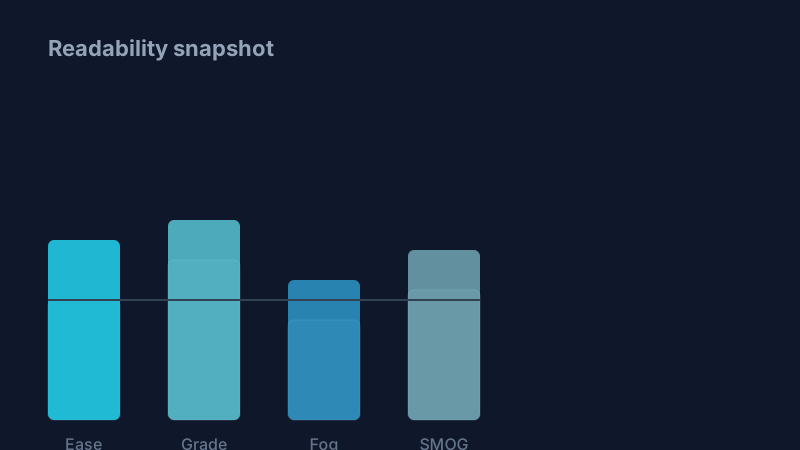
For background on the math, see our Flesch–Kincaid complete guide. For a second opinion on dense nouns and polysyllables, see Gunning Fog explained and the SMOG readability index.
Literacy data: many adults read below “college” level on surveys
Large-scale surveys of adult skills (for example OECD’s PIAAC program) consistently show wide variation in literacy proficiency within and across countries. A substantial share of the population performs everyday reading tasks below the highest proficiency levels—not because people lack intelligence, but because time, language background, fatigue, and context all affect comprehension. That is one reason public-health agencies, governments, and plain-language programs often anchor public-facing guidance around middle-school complexity for broad audiences: it improves reach without assuming every reader has optimal conditions.
Nielsen Norman Group and “lower reading levels” for the web
Usability research firms, including Nielsen Norman Group, have long argued that most web users do not read—they scan, and that clear, concise language supports task completion. NN/g and similar sources frequently recommend targeting roughly lower secondary / eighth-grade complexity for general consumer web content, paired with scannable structure (headings, bullets, meaningful links). The point is efficiency and inclusivity, not talking down: experts also benefit from clear writing when they are in a hurry.
Together, survey literacy patterns, scanning behavior, and plain-language policy explain why “grade 8” shows up so often in content guidelines—even though the exact number is always an approximation.
Why not “always write at grade 6”? Sometimes teams overshoot and produce choppy, repetitive prose. Grade 8 is a widely used compromise: plain enough for mixed literacy, flexible enough for nuance, definitions, and the occasional longer sentence when the idea demands it. The goal is clarity, not the lowest possible number on the dial.
Average reading levels by country and demographic (what to remember)
Country averages from international literacy surveys are useful for context, not for judging individual readers. PIAAC and related programs report distributions of proficiency, not a single “grade” per nation that maps cleanly to Flesch–Kincaid.
Demographics that often correlate with more reading friction on average (again, distributions, not rules) include: non-native speakers of the publication language, older adults dealing with vision or cognitive load, people with lower formal education in that language, and anyone reading under stress (health, money, legal issues). For global products, translation and localization add another layer: short, concrete English at grade 8 often localizes better than idiomatic, abstract prose.
Practical takeaway: If your audience is broad—marketing site, help center, public health, onboarding—grade 8 is a strong default. If your audience is narrow and expert, you may raise the level but still owe them clear sentences and defined terms (more below).
Practical techniques to write for a grade 8 reading level
Sentence length (aim for about 15–20 words on average)
Long sentences are the fastest way to push formulas toward high school and college levels. Aim for an average near 15–20 words for explanatory web prose, while varying length so the rhythm does not feel robotic. When one sentence carries two or three ideas, split long sentences or use a list. See also average sentence length and readability.
Word choice: short, common words first
Prefer Anglo-Saxon everyday verbs (use, help, show, fix) over Latinate filler (utilize, facilitate, demonstrate, remediate) unless the precise term is required. Keep jargon where the audience expects it—but define it once in plain language and link to depth. This aligns with how readability and SEO work together: clarity supports engagement signals.
Paragraph length: about three to four sentences for web
One main idea per paragraph. On screens, walls of text fail the scan test. Three or four sentences (sometimes fewer) per paragraph is a workable default; use subheadings to carry the outline.
Active voice over passive
Passive voice is not “wrong,” but overuse adds words and hides who did what. For instructions, product copy, and most marketing, active usually wins. For a full editing workflow, see passive voice: why it matters.
Concrete language over abstract
Abstract: We will drive operational excellence through stakeholder alignment. Concrete: We will meet every Friday until launch, and each team will post a three-bullet update. Concrete nouns and verbs anchor attention.
One idea per paragraph
If you catch yourself explaining two mechanisms or two decisions in the same paragraph, split. Readers chunk information by paragraph; mixing ideas increases reread rate.
Microcopy and UI strings
Buttons, errors, and empty states are not always scored well by paragraph-based formulas, but the same principles apply: short lines, no double negatives, name the next action (Save, Try again, Contact support). If your product strings read like a policy memo, the rest of the page can be grade 8 and users will still feel friction.
When to target a higher or lower reading level
| Situation | Suggested band | Notes | |-----------|----------------|--------| | General web, email, support, public health | Grade 6–9 (8 as default) | Maximize reach; define terms. | | B2B specialist readers who already know the vocabulary | Grade 10–12+ | Still avoid needless complexity; gloss acronyms on first use. | | Children’s content or very low-literacy audiences | Grade 4–6 | Shorter sentences, more examples, fewer abstract nouns. | | Legal/regulatory required text | Often fixed by counsel | Add a plain-language summary beside it when allowed. |
Voice and tone for teams should lock these targets in; see voice and tone guide for team writing.
Common mistakes that inflate reading level
- Stringing clauses with semicolons instead of breaking into separate sentences.
- Nominalizations (implementation of → we implemented).
- Stacked prepositional phrases (the review of the status of the rollout of the feature).
- Unexplained acronyms on first mention.
- Hedging piles (it could potentially be suggested that → we suggest).
- Passive + vague actor (it was decided → name the decider or use we).
- One sentence doing three jobs—split and use lists.
Tools for measuring and adjusting reading level
- SynthRead — Grade-level style metrics (including Flesch–Kincaid-style signals), sentence-level feedback, and an integrated editing workflow on SynthQuery.
- Built-in checkers in Word and Google Docs — Useful for rough passes; treat scores as comparative across your own drafts.
- Browser extensions and standalone editors (e.g. style-focused writing apps) — Good for highlighting long sentences and passive patterns; always re-read for meaning after automated suggestions.
Use tools to find outliers, not to chase a number into unnatural prose.
Workflow that works in real teams
- Draft without watching the score—get the structure right.
- Measure once; sort issues by long sentences and rare words.
- Rewrite the worst 10–20% of sentences; re-measure.
- Read aloud or use screen-reader preview: awkward grade-6 “fixes” often sound wrong.
- Lock a house target in your style guide so new writers do not guess.
If you use generative AI for first drafts, Humanizer and Grammar can help with cadence and correctness, but you still need a readability pass—SynthRead is built for that loop.
Five before-and-after rewriting examples (grade 8–style clarity)
1. Product update
- Before: In light of the fact that utilization metrics have indicated suboptimal engagement, the decision has been made to extend the beta period.
- After: Engagement in the beta has been lower than we hoped, so we are extending the beta period.
2. Support article
- Before: Should it be the case that authentication fails, verification of credential accuracy should be undertaken prior to escalation.
- After: If sign-in fails, check your email and password. If it still fails, contact support with a screenshot.
3. Health (general audience)
- Before: Medication adherence is facilitated through the establishment of reminder systems.
- After: Reminders help people take medicine on time. Set a phone alarm or use a pill box with the days labeled.
4. B2B (still plain)
- Before: Our platform enables organizations to leverage synergies across stakeholder workflows.
- After: Our platform lets your teams share one workflow so handoffs do not get lost.
5. Internal policy
- Before: Access provisioning requests submitted subsequent to the quarterly cutoff will be processed in the subsequent cycle.
- After: If you request access after the quarterly cutoff, we will process it in the next cycle.
Checklist: Is your content at grade 8?
Use this before you publish broad-reach pages.
- [ ] Average sentence length is near 15–20 words (with intentional variation).
- [ ] Paragraphs stick to one idea and run about 3–4 sentences where possible.
- [ ] Headings describe the section in plain language.
- [ ] Jargon and acronyms are defined on first use—or linked out.
- [ ] Active voice carries most main clauses; passive is rare and purposeful.
- [ ] Concrete examples replace abstract nouns where it helps.
- [ ] Lists break dense instructions into steps.
- [ ] A readability tool shows your draft near your target band; you have manually checked tone for trust and accuracy.
Reading level benchmarks for popular publications (illustrative)
Automated grade scores vary by section, author, and day. Treat these as illustrative patterns, not official publisher targets:
| Publication / type | Typical automated range (Flesch–Kincaid–style tools) | What drives it | |----------------------|------------------------------------------------------|------------------| | Tabloid / mass-market (e.g. The Sun) | Often lower grades | Short sentences, common words, emotional verbs. | | Broadsheet news (e.g. BBC news online) | Often around mid–upper middle school to high school for many articles | Mix of short leads and longer analysis sentences. | | Quality national (e.g. The New York Times) | Often high school+ for long-form | Complex topics, quotes, subordinate clauses. | | Government plain-language pages | Often pushed toward middle school by design | Policy mandate for public comprehension. |
If your brand is closer to Times-style analysis, you might allow a higher score on deep pieces while keeping landing pages, FAQs, and paywalls-adjacent copy closer to grade 8.
Remember: A single viral article’s score does not define your program. Track median grade and 90th-percentile sentence length across your top URLs if you want stable quality over time—especially after template or CMS changes that accidentally lengthen sentences sitewide.
Pulling it together
Learning how to write for a grade 8 reading level is really learning to respect cognitive load: shorter sentences, familiar words, clear actors, concrete detail, and structure that scans. Match the band to the audience, use metrics to compare drafts, and always verify tone and facts outside the formula. When in doubt, cut a clause, name the actor, and swap one long word for a short one—then measure again.
Related on SynthQuery
- Flesch–Kincaid complete guide
- Readability and SEO
- Average sentence length
- Passive voice: why it matters
Tool: SynthRead — Measure grade-level signals, spot hard sentences, and iterate before you ship.

Itamar Haim
SEO & GEO Lead, SynthQuery
Founder of SynthQuery and SEO/GEO lead. He helps teams ship content that reads well to humans and holds up under AI-assisted search and detection workflows.
He has led organic growth and content strategy engagements with companies including Elementor, Yotpo, and Imagen AI, combining technical SEO with editorial quality.
He writes SynthQuery's public guides on E-E-A-T, AI detection limits, and readability so editorial teams can align practice with how search and generative systems evaluate content.
Related Posts
Flesch-Kincaid Readability: The Complete Guide (With Calculator)
The definitive guide to Flesch-Kincaid readability scores: exact formulas, Navy history, interpretation tables, industry benchmarks, limitations, comparisons to Fog and SMOG, SEO guidance, and how to improve your score—with worked examples.
Coleman-Liau Index: Formula, Examples, and When to Use It
A practical guide to the Coleman-Liau readability formula: how it works, worked examples, comparisons with syllable-based scores, and when to choose it in automated pipelines.
Dale-Chall Readability Formula: The Most Accurate Readability Test?
How the Dale-Chall formula uses a familiar-word list to estimate reading grade level, why researchers often prefer it to syllable-only metrics, and when to pair it with Flesch-Kincaid or SMOG.
Get the best of SynthQuery
Tips on readability, AI detection, and content strategy. No spam.