The Legal Status of AI-Generated Content: Copyright, Disclosure, and Detection

- AI
- copyright
- compliance
- SEO
- disclosure
A practical overview of U.S. and international rules on AI-generated works: Copyright Office practice, EU labeling, FTC disclosure expectations, state AI laws, academic and publishing norms, Google’s guidance, and where detection tools fit in compliance workflows.
If you publish or commercialize AI-generated content, you are operating at the intersection of copyright practice, consumer-protection rules, platform policies, and industry norms. Laws and agency guidance are still catching up to the tools, but a coherent picture is emerging: transparency, human creative contribution where copyright is claimed, and quality and honesty toward users and regulators.
This long-form article maps the evolving legal landscape around AI-generated content for U.S. and international teams. It covers U.S. Copyright Office treatment of AI-assisted works, the EU Artificial Intelligence Act transparency expectations, FTC expectations for marketing claims and disclosures, selected state developments, university and publishing policies, Google Search guidance, and how AI detection tools can sit inside a compliance workflow—not as a substitute for legal review.
Disclaimer: This is informational content, not legal advice. Laws differ by jurisdiction and change quickly; consult an attorney for your specific situation.
Why “AI generated content copyright law” is now a business topic
Generative tools can draft marketing copy, code, images, and long-form articles in minutes. That speed collides with rules that assume human authorship for copyright, truthful advertising for regulators, and disclosure where audiences expect to know how content was produced. Teams that treat AI as “just another word processor” without a policy layer risk registration rejections, contract disputes, and enforcement attention—not because AI is banned, but because misrepresentation and low-value output are penalized across multiple fronts.
How to use this guide
Work through the sections that match your risk: copyright if you monetize creative assets, EU and FTC if you sell across borders or run ads, state law if you operate in the U.S., and SEO if organic search is a channel. The timeline and country table at the end anchor dates and jurisdictions.
U.S. Copyright Office: AI-generated works and human authorship
U.S. copyright protects original works of authorship fixed in a tangible medium, with authorship tied to humans. The Copyright Office has applied that principle in high-profile examinations of generative output.
Zarya of the Dawn (2023)
In the Zarya of the Dawn matter, the Office narrowed registration after determining that individual images produced by Midjourney were not the product of human authorship sufficient for protection as registered works, while human-authored text and selection/arrangement could still support registration in part. The decision illustrates the Office’s focus on what a human actually wrote or fixed, versus what a model spat out without creative control described in the application.
- Primary source: U.S. Copyright Office correspondence and registration guidance on Copyright and Artificial Intelligence.
Thaler v. Perlmutter (D.C. Circuit, 2023)
Stephen Thaler sought registration for a work his system generated without a traditional human author named as writer. The U.S. Copyright Office refused; courts upheld that purely AI-generated works, without a qualifying human author as understood under U.S. law, do not receive copyright in that posture. The D.C. Circuit’s August 2023 decision reinforced the Office’s position: copyright law as currently framed centers human creativity.
- Judicial opinion (Court of Appeals for the D.C. Circuit): Thaler v. Perlmutter (PDF).
Practical takeaway for businesses
You can still register works where a human contributes authorship—copy, edits, layout, or materially creative prompts and selections—while accurately disclosing what portions were machine-generated, per Office instructions. Misstating authorship can jeopardize the registration. Always read the latest Copyright Office AI guidance before filing.
EU Artificial Intelligence Act and AI content labeling
The EU Artificial Intelligence Act (Regulation (EU) 2024/1689) establishes a risk-based framework for AI systems placed on the EU market. It distinguishes prohibited practices, high-risk systems, and limited-risk transparency duties, alongside obligations for providers of general-purpose AI models. For many content teams, the headline is not “ban generative AI” but document, label, and monitor where the law says users must understand what they are seeing.
For general-purpose and consumer-facing uses, the Act includes transparency obligations intended to ensure users know when they are interacting with an AI system or when emotion recognition or biometric categorization is in play, and to ensure certain synthetic audio, image, video, or text outputs are machine-readable or labeled where required—subject to phased application by provider category and system type. Exact duties depend on whether you are a deployer, provider, or distributor; importers and authorized representatives also carry obligations in the supply chain.
What teams should plan for
- Product UX: flows that disclose AI-generated or AI-assisted outputs where the Regulation requires it, including clear defaults for chatbots, customer support, and public-facing assistants.
- Documentation: technical documentation, EU declaration of conformity (where applicable), post-market monitoring, and incident reporting scale with risk class—not every blog post triggers high-risk treatment, but foundation-model vendors and regulated vertical integrations often do.
- Third-party APIs: contractually require subprocessors to map their AI Act artifacts (instructions for use, logging, human oversight measures) into your DPA and security reviews.
- Timeline: obligations phase in over 2025–2027 depending on article; verify current dates in the consolidated text, Commission implementing acts, and harmonized standards as they publish.
Treat the Act as a compliance program problem, not a single checkbox—especially if you distribute models, integrate third-party APIs, or serve EU users.
FTC: AI disclosure in marketing and advertising
The U.S. Federal Trade Commission polices deceptive and unfair practices. While not a dedicated “AI statute,” the FTC has made clear that claims about AI must be truthful, substantiated, and not misleading—including how products are made and what automation did or did not do.
Guidance and enforcement context
The FTC’s business guidance has stressed that inflated AI claims and undisclosed use of synthetic media in ads can violate Section 5. Read Keep your AI claims in check (FTC Business Blog, 2023) for the Commission’s plain-language expectations. Related themes appear across FTC advertising and marketing basics: claims must be non-deceptive, evidence-backed, and clear about what humans versus automation contributed.
For endorsements and testimonials, existing rules still require clear disclosure of material connections; AI-generated personas or reviews can implicate the same principles if they mislead consumers. The Guides Concerning Use of Endorsements and Testimonials (16 CFR Part 255) remain the backbone—if an AI voice reads a script, or a synthetic avatar mimics a real expert, material connections and truthfulness still matter.
- Enforcement library (search for AI-related matters): FTC legal library.
Operational pattern
Marketing and comms teams should align creative, legal, and performance metrics: if a reasonable consumer would care whether text or an image was AI-generated, disclose in line with brand and regulatory expectations—before a regulator or competitor asks.
State-level legislation: California, Illinois, Texas
U.S. state legislatures have moved faster than Congress on slices of AI governance—especially election deepfakes, synthetic media, and consumer-facing transparency. The exact statutes and effective dates change; verify the current text through official state portals. Multistate operators should maintain a legislative tracker (bill number, status, effective date, scope) because obligations can differ for political advertising, intimate imagery, employment, and kids’ content.
California
California has advanced multiple bills touching generative AI transparency, election-related synthetic media, and state procurement of AI. Large platforms and publishers face disclosure and reporting concepts that resemble “nutrition labels” for certain system outputs—particularly where watermarking, provenance metadata, or synthetic content labels are discussed alongside consumer rights. Check the California Legislative Information site for enrolled bills (search terms: artificial intelligence, generative, deepfake).
Illinois
Illinois has been an early mover on algorithmic and employment-related AI rules (for example, video interview notice and consent regimes). Content and HR teams that use automated screening, chatbot interviews, or synthetic avatars in hiring flows should review Illinois requirements alongside federal EEO and disability law. Start at the Illinois General Assembly bill search and your counsel’s 50-state survey.
Texas
Texas legislation has addressed deepfakes, election integrity, and government use of AI in various sessions. Campaigns, newsrooms, and brand safety teams operating statewide should monitor Texas Legislature enrolled bills on deceptive media, nonconsensual depictions, and labeling expectations for political ads.
Pattern: States often target harms (fraud, nonconsensual imagery, deceptive political media) rather than banning AI outright. Your risk assessment should list state audiences and distribution channels, then map bills by topic. Where statutes overlap (for example, FTC deception plus state election rules), apply the stricter disclosure standard your counsel recommends.
Academic policy landscape: university-level AI usage
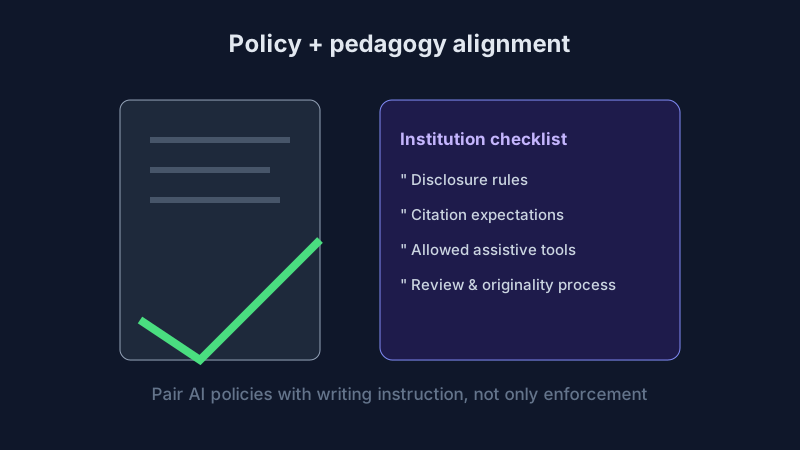
Higher-education institutions worldwide have issued AI use policies that blend integrity, accessibility, and pedagogy. Typical elements include:
- Disclosure when generative tools assist drafts or code.
- Course-level rules that supersede one-size-fits-all bans.
- Limits on using AI in exams or take-home assessments where skill demonstration is graded.
- Appeals that don’t treat automated detectors as infallible.
Accessibility offices often clarify whether AI transcription, summarization, or captioning counts as a reasonable accommodation versus unauthorized assistance on graded work—handbooks increasingly list permitted tools and documentation for disability-related tech. Graduate and professional programs (law, medicine, journalism) may impose stricter norms than central campus defaults, so students and staff should read program-level rules, not only the university-wide policy PDF.
For a SynthQuery-oriented framing of policy design, see Academic integrity and AI policies. Detection belongs in a multi-signal workflow: drafts, process notes, and instructor judgment—not a single score.
Publishing industry standards: journals and magazines
Scientific publishers and major magazines have converged on disclosure and author responsibility:
- Disclose generative tool use in research text, figures, or code when policies require it.
- Verify facts and citations—models hallucinate references.
- Respect third-party rights: training and output licensing remain contested; follow each publisher’s permissions flow.
Editorial teams increasingly run similarity, plagiarism, and AI detection checks as screening tools, then escalate to human editors. Policies differ: some venues ban certain uses; others allow with disclosure. Always read the guide for authors on the journal’s site.
Newsrooms and magazines add ethical layers: bylines imply human accountability even when AI assisted research or formatting; corrections policies apply to AI-assisted errors the same as human ones. Image desks face separate rules for synthetic or altered photography—disclosure expectations in media ethics codes are tightening in parallel with platform policies and state deepfake rules.
SEO: Does Google penalize AI content?
Google’s public messaging has been consistent: automation and AI are not inherently against rules; unhelpful content is. The Search team published explicit guidance in February 2023 that Google Search’s guidance about AI-generated content should be read alongside helpful content principles—focus on people-first quality, expertise, and accuracy, not on whether a human or model typed the first draft.
What Google actually rewards
- Original insight, clear sourcing, and satisfying answers to the query.
- E-E-A-T-style signals where relevant (experience, expertise, authoritativeness, trust).
- Not mass-produced thin pages or keyword-stuffed filler—whether or not AI drafted it.
For a deeper read aligned with SynthQuery’s SEO angle, see Does Google penalize AI content?. The compliance implication: legal and SEO requirements both point to honest, high-quality publication—not a specific prohibition on using AI as a drafting aid.
How AI detection tools fit into compliance workflows
AI detection tools estimate likelihood that text matches patterns common in machine-generated prose. They are not court-admissible proof of authorship and can false-positive on human writers or edited AI drafts.
Sensible workflow
- Policy first: Define when disclosure is required (marketing, academic, contractual).
- Draft and edit: Humans add facts, examples, and brand voice.
- Detection as a screen: Run detection to flag sections for review—not automatic rejection.
- Document: Keep version history and disclosure records for enterprise clients.
- Appeals: For sensitive decisions, pair tools with detection limitations awareness.
Used this way, detection supports risk management and editorial QA, not legal conclusions.
What businesses should disclose about AI content
A practical checklist:
- Copyright applications: Follow Copyright Office instructions on human authorship and AI-generated material.
- Advertising: Avoid unsubstantiated superlatives about what AI did; align with FTC guidance.
- EU-facing products: Map AI Act transparency duties to UX and vendor contracts.
- State campaigns: Review deepfake and political content rules where applicable.
- Contracts: Specify ownership, warranties, and representations about generative tools in MSAs and freelancer agreements.
- SEO: Publish helpful, accurate pages; disclose AI assistance if your brand promises human-only authorship.
Insurance and enterprise RFPs increasingly ask whether vendors log prompts, retain outputs, and train on customer data—answer those questions consistently with your privacy policy and subprocessor list.
Timeline of key legal and policy milestones (2023–2026)
| Period | Development | |--------|-------------| | Feb 2023 | U.S. Copyright Office Zarya of the Dawn decision clarifies limited registration when AI-generated images lack human authorship; Office AI portal updated over time. | | Feb 2023 | Google Search publishes guidance on AI-generated content emphasizing helpfulness over authorship tool. | | Aug 2023 | D.C. Circuit affirms denial of registration for purely AI-generated work claimed without human author in Thaler v. Perlmutter. | | 2024 | EU Artificial Intelligence Act adopted; consolidated text sets phased obligations. | | 2024–2025 | U.S. states advance deepfake, election, and platform transparency bills—check CA, IL, TX portals. | | 2025–2026 | Phased EU AI Act duties; continued FTC scrutiny of AI marketing claims; publishers refine author disclosure rules. |
Country-by-country AI content regulation (high level)
Regulation mixes sector rules, consumer law, and AI-specific statutes. Status is not uniform; treat this table as a starting point for legal intake—not a definitive compliance matrix.
| Country / region | Copyright posture (typical) | Content / AI labeling | |-------------------|-----------------------------|-------------------------| | United States | Human authorship central to copyright; USCO AI guidance. | FTC truth-in-advertising; state laws on synthetic media and elections. | | European Union | National copyright laws; EU-wide text and data mining exceptions vary by use. | EU AI Act transparency and risk management by system class. | | United Kingdom | Human authorship and originality tests under UK law; consultations on AI and IP continue. | Online Safety and consumer frameworks interact with platform duties; follow UK legislation updates. | | Canada | Copyright Act reform proposals address AI and authorship; monitor Parliament of Canada bills. | PIPEDA-class privacy and provincial laws affect automated decisions in some contexts. | | Australia | Copyright Office–style questions handled under Australian law; TDM and fair dealing debates ongoing. | ACCC consumer law; OAIC guidance on automated processing. |
Key external resources
- U.S. Copyright Office — Artificial Intelligence — Registration policy and FAQs.
- EU Artificial Intelligence Act (EUR-Lex) — Full legal text.
- Google Search guidance on AI-generated content — Official Search Central post.
- FTC business guidance on AI claims — Substantiation and honesty expectations.
- Thaler v. Perlmutter (D.C. Circuit) — Opinion PDF.
Related reading on SynthQuery
- How to detect AI-generated content — Workflow and limits.
- Academic integrity and AI — Campus policy patterns.
- Does Google penalize AI content? — SEO angle with Google’s framing.
Disclaimer: This article is for general information only and does not constitute legal advice. Consult a qualified attorney in your jurisdiction before making decisions about copyright registration, advertising claims, or cross-border AI deployment.

Itamar Haim
SEO & GEO Lead, SynthQuery
Founder of SynthQuery and SEO/GEO lead. He helps teams ship content that reads well to humans and holds up under AI-assisted search and detection workflows.
He has led organic growth and content strategy engagements with companies including Elementor, Yotpo, and Imagen AI, combining technical SEO with editorial quality.
He writes SynthQuery's public guides on E-E-A-T, AI detection limits, and readability so editorial teams can align practice with how search and generative systems evaluate content.
Related Posts
Content Briefs That Work: How to Plan SEO Content in 2026
A field-tested SEO content brief template, research workflow, writer handoff checklist, and ways to measure whether your briefs actually produce rankings.
What Is E-E-A-T? Google's Content Quality Framework Explained (2026)
A full guide to Experience, Expertise, Authoritativeness, and Trustworthiness—how Google talks about content quality, how raters use E-E-A-T, and how to implement it for search and AI-cited answers.
Word Count and SEO: The Ideal Blog Post Length in 2026
There is no magic number for ideal blog post length in 2026: only intent, depth, and how well you satisfy the query. Here is what the data suggests, how AI Overviews change the game, and how to pick the right length for your topic.
Get the best of SynthQuery
Tips on readability, AI detection, and content strategy. No spam.