What Is E-E-A-T? Google's Content Quality Framework Explained (2026)

- E-E-A-T
- SEO
- content quality
- YMYL
- GEO
A full guide to Experience, Expertise, Authoritativeness, and Trustworthiness—how Google talks about content quality, how raters use E-E-A-T, and how to implement it for search and AI-cited answers.
If you are trying to rank—or to get cited in AI overviews—you will keep seeing the same four letters: E-E-A-T. People ask what is EEAT Google because the acronym shows up in SEO courses, audits, and “helpful content” discussions, but it is rarely explained end-to-end in one place.
E-E-A-T is Google’s content quality framework: a way to describe what makes a page helpful and reliable, especially when the wrong answer could hurt someone—or when many credible sites compete for the same query. It is not a single dial in a public ranking API. It is a lens Google uses in documentation, in Search Quality Rater Guidelines, and in how teams think about page quality and trust.
This guide defines each pillar, traces how we got from E-A-T to E-E-A-T, explains how evaluation actually works in practice, and gives a rubric, checklist, and before/after examples you can apply this week—whether you publish medical advice, financial explainers, product reviews, or B2B software content. For a fast publish gate, pair this with our E-E-A-T content checklist for competitive topics.
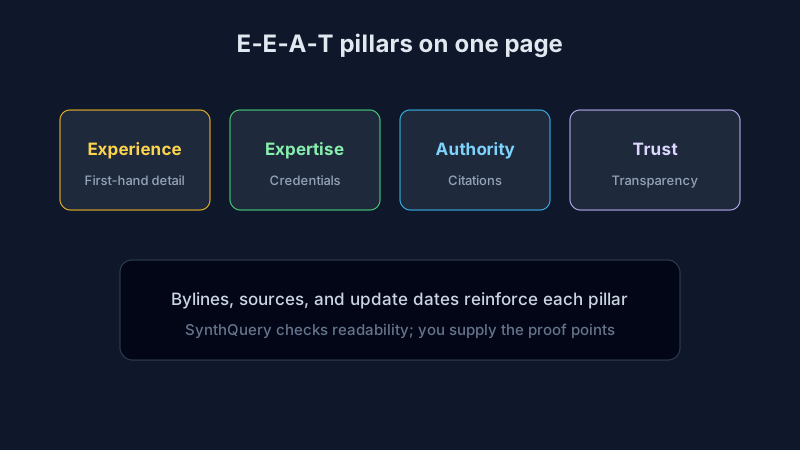
What does E-E-A-T stand for?
E-E-A-T expands to:
| Letter | Term | In plain language | |--------|------|-------------------| | E | Experience | Did the creator actually do the thing—use the product, run the experiment, visit the place, live through the situation? | | E | Expertise | Do they have the skills and knowledge expected for the topic (training, professional practice, depth)? | | A | Authoritativeness | Is the site or creator known as a go-to source—cited, referenced, linked, and recognized in the field? | | T | Trustworthiness | Is the page accurate, transparent, and safe—with honest sourcing, clear ownership, and appropriate care on sensitive topics? |
Google often places trust at the center conceptually: without trust, strong-looking experience or credentials do not help users. That is why many SEO discussions summarize the framework as “build trust through demonstrated experience, relevant expertise, and real authority.”
One more clarification helps newcomers: E-E-A-T is not a license to treat every blog post like medical advice. The framework is contextual. A recipe site, a coding tutorial, and a page on retirement withdrawals all need trust, but they do not all need the same credentials—they need the right credibility for the user’s decision.
Visual: E-E-A-T as a framework (conceptual)
The four pillars support trust and user confidence. Raters are trained to look for overlaps—for example, a medical article might lean heavily on expertise and trust (accurate, reviewed), while a gear review might lean on experience and authoritativeness (hands-on testing + recognition).
                    ┌──────────────────┐
                    │   TRUST (core)   │
                    │ accuracy · safety │
                    │   transparency   │
                    └────────┬─────────┘
           ┌───────────────┼───────────────┐
           │               │               │
     ┌─────▼─────┐   ┌─────▼─────┐   ┌─────▼─────┐
     │ EXPERIENCE │   │ EXPERTISE │   │ AUTHORITY │
     │ first-hand │   │ credentials│  │ citations │
     │  testing   │   │  depth     │  │  mentions │
     └────────────┘   └───────────┘   └───────────┘
History: from E-A-T to E-E-A-T (and why “Experience” matters)
The E-A-T era
For years, Google’s quality conversations centered on E-A-T: Expertise, Authoritativeness, Trustworthiness. That framing matched a simple user need: on topics where bad advice is dangerous, who wrote the content and whether you can trust the page matter as much as keyword relevance.
December 2022: Experience joins the framework
In December 2022, Google updated its guidance to add Experience, creating E-E-A-T. The practical shift is straightforward: first-hand life experience can be a quality signal even when the creator is not a credentialed expert—if the content is trustworthy and appropriate for the query.
Examples Google and the SEO community commonly cite:
- A product review with real usage, photos, and limitations called out honestly.
- A travel guide from someone who actually visited a place versus a rewrite of brochure copy.
- A hobbyist forum answer that reflects lived troubleshooting, not generic instructions.
That does not remove expertise requirements for YMYL (Your Money or Your Life) topics where professional guidance is expected—it adds a new question where lived experience is legitimately valuable.
December 2025 and “competitive queries” (what changed in practice)
Google has long said that trust matters broadly, not only on obviously sensitive topics. After the December 2025 broad core update rolled out (starting December 11, 2025), many publishers and tool vendors reported volatility across non-YMYL verticals too—especially where SERPs are crowded with similar articles and differentiation by depth is hard.
The useful way to read “E-E-A-T for all competitive queries” is not that finance and health stop mattering most. It is that any query where multiple credible sources compete rewards pages that clearly demonstrate experience, expert verification where needed, recognition, and trust mechanics (sources, updates, transparency)—not pages that sound authoritative but read interchangeable.
For Google’s own framing of what it means to create helpful, reliable, people-first content, start with Google Search Central’s documentation on creating helpful content and the Search Quality Rater Guidelines (PDF).
Deep dive: each component (what “good” looks like)
Experience: first-hand knowledge, testing, and specifics
Experience answers: Did you actually encounter this?
Strong signals include:
- Methodology: how you tested, what you controlled for, sample sizes, timelines.
- Artifacts: screenshots, photos, logs, receipts (where appropriate), version numbers.
- Failure modes: what did not work—specificity beats a purely positive template.
- Context: constraints that matter to the reader (budget, region, device, audience).
Weak experience signals are easy to spot: vague adjectives, stock narratives, “ultimate guide” language with no proof, or details that could apply to any competitor.
Expertise: credentials, education, and relevant background
Expertise answers: Should this person—or this organization—be advising on this topic?
Strong signals include:
- Relevant degrees, licenses, certifications where standard in the field.
- Bylines with verifiable professional history (and scope—what they are not claiming).
- Editorial review for sensitive content (medical, legal, tax) when appropriate.
- Demonstrated depth: definitions, edge cases, appropriate nuance.
Expertise is topic-relative. A credentialed expert writing outside their lane still needs to show appropriate care—or collaborate with a qualified reviewer.
Authoritativeness: recognition, citations, and the web of trust
Authoritativeness answers: Do others treat this source as a reference point?
Strong signals include:
- Citations from independent reputable sources.
- Backlinks and mentions from recognized publications, institutions, or practitioners.
- Consistent entity signals: a brand/author people associate with a topic cluster.
- Original contributions: data, definitions, frameworks others borrow.
Authority is not “many links.” It is the right links and references for the niche—especially from entities that themselves carry trust.
Trustworthiness: transparency, accuracy, security, and privacy
Trustworthiness answers: Can users rely on this page—and the site behind it?
Strong signals include:
- Accurate claims tied to sources; visible last updated dates when facts evolve.
- Clear ads, sponsorship, and affiliate disclosures where required.
- About, contact, and policies that match the site’s claims.
- Secure browsing basics (HTTPS), honest UX, and no deceptive patterns.
On YMYL topics, trust also includes alignment with consensus guidance where that is the standard of care—and clear escalation (“see a professional”) when needed.
How Google evaluates E-E-A-T (raters vs ranking systems)
This is the part SEO Twitter argues about, so it is worth being precise.
Quality Rater Guidelines are training data—not a public score
Google employs search quality raters who follow the Search Quality Rater Guidelines. Raters assign page quality concepts—including E-E-A-T signals—to example URLs. That process helps Google calibrate systems that aim to reward helpful, trustworthy content.
What raters do not do is move your site up or down directly with a personal E-E-A-T dial.
What raters actually look for (useful for editors)
Even though you are not “writing for raters,” the guidelines read like a quality checklist because they describe failure modes users hate: thin pages, misleading titles, unsupported claims, conflicts of interest hidden in reviews, and stale advice on fast-moving topics.
A few recurring themes map cleanly to publishing work:
- Main content quality: does the page genuinely answer the query, or is it mostly filler?
- Supplementary content: do ads or promos overwhelm the answer?
- Reputation research: what do independent sources say about the site or author—especially for YMYL?
- E-E-A-T: does the page show appropriate experience and/or expertise, and is it trustworthy?
If your page would embarrass you in front of a careful editor, it is unlikely to look “high quality” under that lens—regardless of who wrote the draft.
Systems approximate “what users value”
Google describes multiple ranking systems and updates over time (core updates, spam policies, helpful content systems—naming evolves). The takeaway for publishers is practical: build pages that satisfy intent and earn trust the way a careful human would evaluate—not by chasing a mythical “E-E-A-T score.”
Why “not a direct ranking factor” still changes what you publish
You will sometimes hear Googlers describe concepts like E-E-A-T as not a single ranking signal in the simplistic sense. That is compatible with a second truth: many signals search systems use—links, content quality classifiers, helpfulness evaluations, spam detection—approximate trust and credibility.
So the actionable translation is not semantic debate. It is operations: make trust easy to perceive—for users, for journalists, for partners, and for the kinds of patterns automated systems are designed to reward when they align with user satisfaction.
If you want the official overview hub, bookmark Google Search documentation and read updates alongside the Google Search Status Dashboard when volatility hits.
E-E-A-T by content type (how emphasis shifts)
Medical and health
Prioritize expertise and trust: sourcing to high-quality medical references, expert review, clear limitations, and safe phrasing. Experience can complement (patient journeys) but rarely replaces professional guidance for diagnosis or treatment content.
Financial
Prioritize trust and expertise: methodology for claims, dates, conflicts of interest, regulatory sensitivity, and careful handling of “advice” vs education.
News and investigative reporting
Prioritize trust and authoritativeness: named journalists, editorial standards, corrections policy, primary documents, and transparent sourcing.
Reviews and affiliates
Prioritize experience and trust: hands-on proof, comparison methodology, price and date context, and clear affiliate relationships.
Tools, SaaS, and technical documentation
Prioritize experience + expertise: reproducible steps, versioned instructions, screenshots, API realities, and “what breaks in production” honesty—signals that separate docs from marketing fluff.
Local services and “near me” intent
Prioritize trust + local legitimacy: consistent NAP-style details (name, address, phone) where applicable, real teams, real locations, legitimate review patterns, and transparent pricing/service boundaries. Experience still matters—show the work: before/after (where ethical), process photos, and scoped guarantees.
Educational content and how-to
Prioritize clarity + trust: step order that works, prerequisites, troubleshooting, and explicit “what this is not” boundaries. Experience shows up as realistic failure cases; expertise shows up when the topic genuinely requires specialized training.
Scoring rubric: weak vs strong E-E-A-T signals
Use this as an editorial rubric, not a literal grade Google prints for you.
| Dimension | Weak | Medium | Strong | |----------|------|--------|--------| | Experience | Generic claims; no proof | Some specifics; limited evidence | Clear methodology; artifacts; limitations | | Expertise | Anonymous or irrelevant | Credible byline; partial fit | Recognized credentials and appropriate scope | | Authoritativeness | No references; isolated site | Some citations; occasional mentions | Recognized across niche; cited by peers | | Trustworthiness | Thin policies; sloppy facts | Mostly accurate; decent transparency | Sources, updates, disclosures, safe UX |
Practical checklist: 20+ actions (implementation)
- Add a real author profile with expertise scope (“writes about X, not Y”).
- Show credentials only where relevant—avoid credential stuffing.
- Add last reviewed or last updated on facts that change.
- Link to primary sources (studies, regulators, official docs).
- Replace sweeping claims with bounded claims (“in our test…”, “in this cohort…”).
- Publish a clear corrections policy.
- Make contact and about easy to find.
- Disclose affiliates, sponsorships, and samples provided by vendors.
- For reviews, document how you tested—criteria, duration, environment.
- Add images or logs that are hard to fake cheaply (where appropriate).
- Remove stock filler paragraphs that repeat SERP boilerplate.
- Consolidate duplicate angles into one authoritative page when possible.
- Build internal links that show topical depth (clusters, hubs).
- Earn mentions ethically—PR, podcasts, community participation, original research.
- Keep YMYL pages aligned with consensus guidance where that is the standard.
- Avoid anonymous testimonials; prefer verifiable case patterns.
- Fix security basics and avoid deceptive interstitials.
- Make policies match practices (privacy, refunds, data use).
- Use structured data where honest and accurate (not as a gimmick).
- Improve readability for clarity—confusing instructions erode trust; use SynthRead to tighten structure.
- If you use AI drafting, add human verification, expert review where needed, and unique value—see does Google penalize AI content?.
- Track fact drift—refresh pages when regulations, pricing, or specs change.
Before-and-after: improving E-E-A-T signals (two quick examples)
Example A: Software review
Before: “This tool is great for teams. It has many integrations and good support. We recommend it for productivity.”
After: “We migrated a 12-person support team from Tool A in March 2026; import took ~2 hours, and we hit two edge cases (CSV date formats and SSO group mapping). Support responded in under 30 minutes on both. Here is what worked—and what we would do differently next time.”
The after version demonstrates experience (specifics), trust (limitations), and authority-by-proof (a reader can judge relevance).
Example B: Health explainer (non-diagnostic)
Before: “This supplement cures inflammation fast.”
After: “This article summarizes what clinical reviews typically study (population, dose, duration), what remains uncertain, and when to talk to a clinician—with citations to reputable sources and a medical review by [qualified role].”
The after version aligns with trust and expertise expectations for YMYL-adjacent topics—without overclaiming.
E-E-A-T and AI content: can AI demonstrate E-E-A-T?
AI tools can help you draft, outline, or summarize public knowledge. They do not automatically provide first-hand experience, accountability, or independent verification.
To make AI-assisted content align with E-E-A-T-style quality:
- Add human verification, especially for YMYL.
- Inject proprietary data, screenshots, interviews, and product-specific detail.
- Cite sources and show how conclusions were reached.
- Keep disclosure aligned with brand, legal, and academic rules.
For a grounded take on detection limits (useful for workflows, not “proof” of quality), see ChatGPT detection limitations.
E-E-A-T for GEO: how AI search surfaces choose what to trust
Generative Engine Optimization (GEO) is not “E-E-A-T 2.0,” but the overlap is real: AI answers tend to quote or summarize pages that are easy to verify, well structured, and credibly sourced.
Why “trust signals” show up in AI-cited answers
Generative systems face an attribution problem: they need sources that look checkable and low-risk to summarize. That pushes visibility toward pages with:
- Named authors and institutions readers recognize (or can verify).
- Explicit sourcing (links to primary documents, regulators, academic papers).
- Stable URLs and pages that are maintained over time.
- Clear scope—so the model is less likely to overgeneralize your claims.
None of that replaces classic SEO—search still rewards intent match, crawlability, links, and technical health—but GEO adds a premium on extractability: short, well-bounded sentences next to evidence.
Practical GEO alignment with E-E-A-T
- Write quotable lines—clear claims with citations.
- Use headings and definition-led paragraphs that map to common questions.
- Prefer primary references over recycled blog summaries.
- Maintain freshness on fast-moving topics.
- Add FAQ-style sections only when they reflect real user questions—avoid boilerplate FAQs stuffed with synonyms.
A simple GEO test before you publish
Ask: “Could a skeptical editor verify the key claim in under five minutes using sources linked from this page?” If not, strengthen trust first—then tune phrasing for readability.
If you want readability discipline that supports both humans and snippets, pair E-E-A-T work with readability and SEO.
External resources (official docs + research)
- Search Quality Rater Guidelines (PDF) — how raters are trained to judge page quality and E-E-A-T-style signals.
- Google Search Central: creating helpful, reliable, people-first content — publisher guidance straight from Google’s documentation hub.
- Google Search documentation hub — index of SEO fundamentals, including documentation updates over time.
Third-party and academic research will not reveal Google’s internal formulas, but it can still inform strategy.
- Vendor “studies” (Semrush, Ahrefs, and similar) often measure correlations between page attributes and visibility. They can surface useful patterns—for example, how top results structure headings or cite sources—without proving a single causal lever.
- HCI and credibility research (university and industry papers on trust cues, misinformation resistance, and evaluation of online expertise) can sharpen your editorial standards—especially for teams trying to separate “sounds authoritative” from “is defensible.”
Treat external research as a hypothesis generator: run your own tests, track outcomes for your site and your queries, and keep professional review where topics demand it.
Key takeaways
- E-E-A-T is Google’s framework for discussing experience, expertise, authority, and trust—with trust as the unifying goal.
- The shift from E-A-T to E-E-A-T formalizes that first-hand experience can matter when it truly helps users—alongside expertise where expertise is required.
- Rater guidelines teach concepts used to evaluate quality; they are not a personal ranking remote control for your domain.
- Winning competitive SERPs increasingly looks like demonstrated depth: proof, specifics, credible sourcing, and transparent site operations—then making it easy for both humans and AI systems to verify why your page should be believed.
- If you only do one thing after reading this: pick your highest-risk pages (money, health, safety, or high-competition commercial intent) and upgrade one trust primitive on each—source, date, byline, disclosure, or methodology. Small, credible edits compound faster than another “ultimate guide” rewrite.
Related reading and tools
- E-E-A-T content checklist (2026) — publish-ready checks for competitive topics.
- Internal linking and topical authority — structure that supports depth.
- SynthRead — readability and structure for clearer, more trustworthy pages.
SynthQuery publishes practical SEO and content quality guides. Nothing in this article is a guarantee of rankings; apply editorial judgment and professional review where topics require it.

Itamar Haim
SEO & GEO Lead, SynthQuery
Founder of SynthQuery and SEO/GEO lead. He helps teams ship content that reads well to humans and holds up under AI-assisted search and detection workflows.
He has led organic growth and content strategy engagements with companies including Elementor, Yotpo, and Imagen AI, combining technical SEO with editorial quality.
He writes SynthQuery's public guides on E-E-A-T, AI detection limits, and readability so editorial teams can align practice with how search and generative systems evaluate content.
Related Posts
Content Briefs That Work: How to Plan SEO Content in 2026
A field-tested SEO content brief template, research workflow, writer handoff checklist, and ways to measure whether your briefs actually produce rankings.
E-E-A-T Content Checklist for YMYL and Competitive Topics (2026)
Experience, expertise, authoritativeness, and trust—turned into a publish checklist for pages that compete on credibility, not just keywords.
How to Write AI-Proof Content That Ranks in Google and AI Search
Learn what AI-proof content means for SEO and GEO, how to optimize for Google and AI Overviews together, and a practical workflow—plus a 20-point quality checklist and citation-ready passage examples.
Get the best of SynthQuery
Tips on readability, AI detection, and content strategy. No spam.