Does Google Penalize AI Content?

- ai
- seo
What Google’s helpful-content and spam guidance actually say about AI-assisted publishing, E-E-A-T, thin content risk, and how to audit drafts with detection and SynthRead.
The question "Does Google penalize AI content?" is everywhere. The short answer: Google does not reject pages solely because a model assisted with drafting. Search systems reward helpful, reliable, people-first content—see Google’s guidance on creating helpful content—and demote low-quality or manipulative pages regardless of authorship. This post connects that public framing to practical publishing: originality, experience signals, and editorial standards. When you still need to verify drafts (brand safety, academic rules, or editorial policy), run an AI Detector pass alongside human review—not as a substitute for how detection actually works.
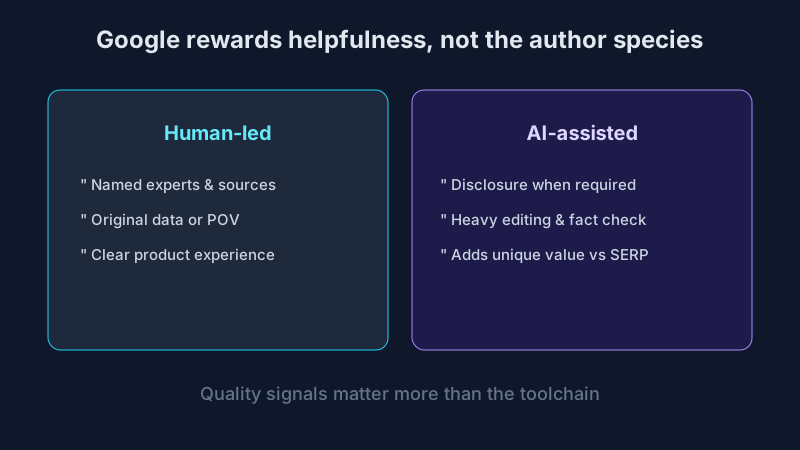

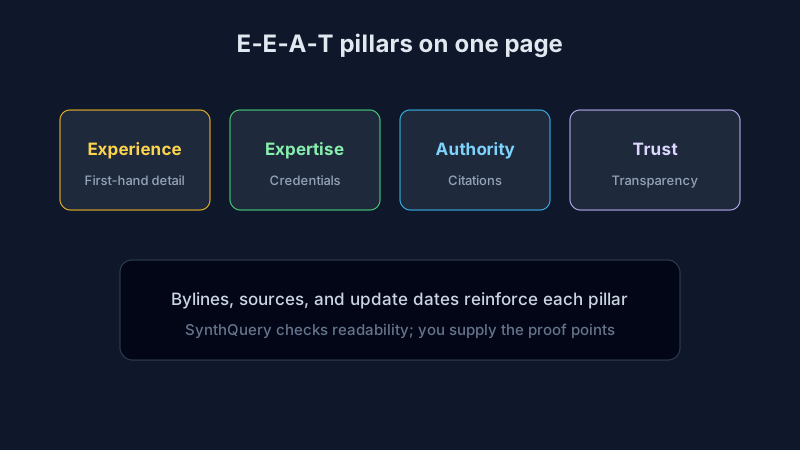
Table of contents
- What Google says about AI-generated content
- Helpful content vs spam and scaled abuse
- Why “AI penalty” is a misleading phrase
- What to do when you publish AI-assisted content
- E-E-A-T, readability, and originality
- Related tools and further reading
What does Google say about AI-generated content?
Google’s public guidance focuses on helpfulness and quality, not on banning a specific writing tool.
Helpful, original content—regardless of tool
Google’s guidance is clear: automation (including AI) is allowed. What matters is whether the content meets the same quality bar as good human content. It should be useful, accurate, and not designed to manipulate search results. So the issue isn’t "AI vs. human"; it’s "helpful vs. unhelpful" and "original vs. thin or copied."
E-E-A-T and readability still apply
If your AI-assisted content is substantive, well-edited, and aimed at satisfying the user, you’re aligned with that. If you’re pumping out low-value pages to capture queries, you’re at risk regardless of who wrote the words. Focus on E-E-A-T (experience, expertise, authoritativeness, trustworthiness) and on readability so people can actually use the content. Tools like SynthRead help you keep readability and structure in check.
Originality and experience signals
Add first-hand detail—data, examples, interviews—so pages aren’t interchangeable with generic model output; that aligns with E-E-A-T expectations on competitive queries.
Helpful content vs spam and scaled abuse
Google’s spam policies discuss behaviors like scaled content abuse—churning many pages to match queries without adding value—not a literal “ban on GPT.” The risk is automation used to flood the index with thin or duplicative pages. That is conceptually adjacent to older “thin affiliate” and “doorway” problems: the issue is user value, not whether a human pressed “generate.”
What teams should audit
- Uniqueness: does each URL justify its existence with evidence, perspective, or data?
- Overlap: are you publishing ten near-identical location pages with swapped city names?
- Velocity: are you shipping faster than you can fact-check?
If the answer is uncomfortable, fix the editorial model—not only the AI settings.
Why “AI penalty” is a misleading phrase
People often conflate “machine-written” with “low quality,” and low-quality pages have always been risky—so the warning gets misremembered as an AI ban.
Thin content and stereotypes
Early AI output was often generic, repetitive, and thin. That kind of content has always been at risk under Google’s quality guidelines. So when people say "Google penalizes AI," they often mean "Google demotes low-quality content," and a lot of that used to be obviously machine-written.
Why the line keeps moving
As AI output improves and is edited by humans, the line blurs. The best approach is to assume Google is agnostic to the tool and strict about quality.
Misleading headlines and vendor claims
SEO Twitter and tool marketing often imply a special “AI penalty”—that shorthand confuses spam and thin content risks with authorship labels.
Detector scores vs. search quality
AI probability tools measure statistical style—not helpfulness. Don’t confuse a clean detection score with a page that satisfies the query.
What Googlers have said about “reading level” and simplistic metrics
Search advocates have long cautioned SEOs against treating surface metrics as direct ranking levers. The useful takeaway is not “ignore clarity,” but “don’t substitute a formula for substance.” Pair readability work with intent coverage, internal links, and backlinks—rankings are multi-signal.
What should you do when you publish AI-assisted content?
Treat AI as a drafting or research aid, then edit for accuracy, originality, and clear structure—same bar you would apply to any other draft.
Draft, edit, and add unique value
Use AI to draft, research, or expand—then edit, fact-check, and add unique value. Make sure your content has a clear purpose, answers the query, and is easy to read. Run it through a readability checker and fix hard sentences. Add experience or expertise where you can (examples, data, quotes). Disclose AI use if your brand or industry expects it.
What to avoid at scale
Avoid mass-producing near-duplicate pages or stuffing keywords. If you wouldn’t publish the same content without AI, don’t publish it with AI either.
Disclosure when stakeholders require it
Some industries and contracts require disclosure of AI assistance—align SEO practice with brand, legal, and academic rules, not only algorithms.
Editorial workflow (high level)
| Stage | Human-led question | Tooling (optional) | | --- | --- | --- | | Outline | Does this structure match sub-intents? | Brief, keyword map | | Draft | Are claims sourced? | Research notes | | Revise | Is voice on-brand? | Humanizer only if policy allows | | Verify | Are facts and quotes correct? | Editors, SMEs | | Measure | Did we satisfy the query? | Search Console, engagement |
The bottom line on quality vs. authorship
Google does not need to know who typed every word; it needs to see helpful, original, trustworthy pages.
Quality-first strategy
Google doesn’t penalize AI content per se. It rewards helpful, original, trustworthy content.
Where AI fits long term
Write and edit with that in mind, use AI where it helps, and keep readability and user value front and center. That’s the strategy that holds up regardless of algorithm updates. For limits on “AI probability” scores in high-stakes settings, see ChatGPT detection: what tools can’t prove; for provenance trends, watermarking AI text rounds out the picture.
Keep a human review gate for YMYL
For health, finance, or safety topics, expert review remains non-negotiable—AI drafting doesn’t replace professional accountability.
E-E-A-T, readability, and originality
Experience means first-hand involvement with the topic—show it with specifics readers can verify (measurements, photos, dated observations). Expertise is domain depth; authoritativeness is recognition from others; trust is accuracy, sourcing, and transparency. AI can help draft, but it cannot invent those signals—you still add them in editing.
Readable structure supports E-E-A-T by making claims checkable: clear headings, labeled methods, and citations readers can follow. Use SynthRead to remove unnecessary friction; use editors to remove unnecessary risk.
Practical checklist before you ship
- Answer the query in the first screen for informational intent.
- Cite primary sources where stakes are high (health, money, safety).
- Disclose AI assistance when policy or law requires it.
- Run detection only where your workflow needs a risk signal—not as a substitute for quality review.
When rankings drop, avoid lazy attribution
Sitewide traffic changes can come from core updates, technical regressions, seasonality, or SERP feature shifts—not “because we used AI.” Document what changed (template, crawl, indexation, intent mix) before you blame tooling. The Google Search Status Dashboard helps separate widespread updates from local mistakes.
International sites
If you publish multiple languages, quality and hreflang hygiene matter as much as English copy. Machine translation without native review can produce “fluent” text that still fails E-E-A-T for local readers.
Product and support content
AI drafts of help-center articles can sound complete while omitting edge cases your agents see daily. Mine ticket logs for FAQs, then cite real customer language. That is how you convert generic model tone into experience Google can trust.
If you syndicate the same article to Medium, LinkedIn, or partners, add canonical tags and avoid duplicate blobs that compete with your own domain—automation makes duplication cheap; search systems still dislike it.
Bottom line: automation raises throughput; Google still rewards differentiation.
Related tools and further reading
SynthQuery tools
- AI Detector — AI vs. human signals when policy or brand requires a check.
- SynthRead — Readability, structure, and grade-level alignment for helpful content.
On this blog
- How to detect AI-generated content — Practical detection workflow beyond SERP theory.
- ChatGPT detection limitations — Why scores aren’t forensic proof.
- Watermarking AI text — Provenance layers alongside classifier scores.
- Readability and SEO — Clear writing, engagement, and search.
- E-E-A-T content checklist — Experience and trust signals in one pass.
External references
- Google Search Central — Creating helpful, reliable, people-first content
- Google Search Central — Spam policies for Google web search (includes guidance relevant to scaled/low-value content)
- Google Search Status Dashboard — follow ranking updates when diagnosing sitewide changes—avoid attributing volatility to “AI” without evidence.

Itamar Haim
SEO & GEO Lead, SynthQuery
Founder of SynthQuery and SEO/GEO lead. He helps teams ship content that reads well to humans and holds up under AI-assisted search and detection workflows.
He has led organic growth and content strategy engagements with companies including Elementor, Yotpo, and Imagen AI, combining technical SEO with editorial quality.
He writes SynthQuery's public guides on E-E-A-T, AI detection limits, and readability so editorial teams can align practice with how search and generative systems evaluate content.
Related Posts
Readability Scores and SEO: Do They Actually Affect Rankings?
What Google says about readability as a ranking factor, what large SEO studies measured, and how to improve clarity for users and AI-cited answers—without dumbing down your expertise.
The Legal Status of AI-Generated Content: Copyright, Disclosure, and Detection
A practical overview of U.S. and international rules on AI-generated works: Copyright Office practice, EU labeling, FTC disclosure expectations, state AI laws, academic and publishing norms, Google’s guidance, and where detection tools fit in compliance workflows.
How to Write AI-Proof Content That Ranks in Google and AI Search
Learn what AI-proof content means for SEO and GEO, how to optimize for Google and AI Overviews together, and a practical workflow—plus a 20-point quality checklist and citation-ready passage examples.
Get the best of SynthQuery
Tips on readability, AI detection, and content strategy. No spam.