ARI (Automated Readability Index): Formula and Practical Guide

- Automated Readability Index
- readability
- ARI
- editing
- NLP
Learn how the Automated Readability Index works, why it counts characters instead of syllables, how to interpret ARI scores against US grade levels, and when ARI beats—or falls short of—formulas like Coleman-Liau and Flesch–Kincaid.
What is the Automated Readability Index?
The Automated Readability Index (ARI) is a readability formula that estimates the U.S. school grade level required to understand a passage of English text. Unlike metrics that rely on syllable counts, ARI uses average characters per word and average words per sentence. That makes it fast to compute in software and attractive for large-scale text processing, content management systems, and natural language pipelines where syllabification would be expensive or brittle.
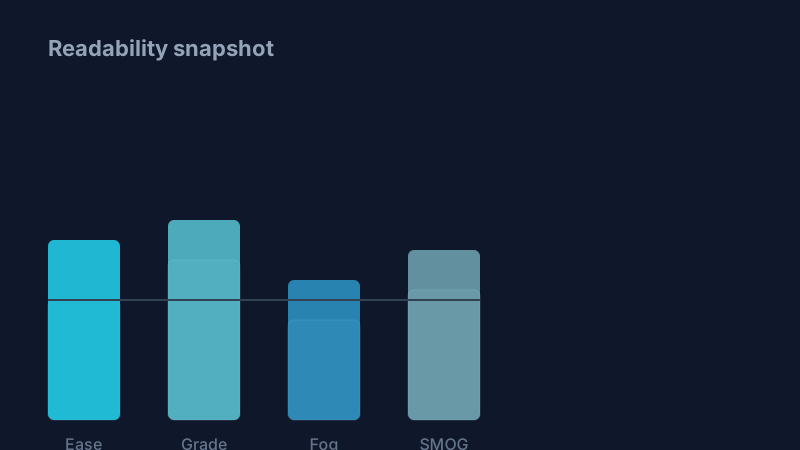
If you are comparing readability metrics for the same draft, run ARI next to Flesch–Kincaid, Gunning Fog, and SMOG in SynthRead—then fix the sentences that move several scores at once.
Origin: US military technical manuals (1967)
ARI was developed in 1967 by Smith and Senter as part of work on automated readability assessment for U.S. military technical manuals. The goal was practical: commanders and trainers needed consistent, repeatable estimates of how difficult maintenance and operations prose would be for personnel, and they needed those estimates at scale. Hand-counting syllables for every manual revision was not viable; counting characters and sentence boundaries was.
That origin explains ARI’s engineering bias: it favors deterministic counting rules that machines can apply uniformly. The formula was not designed to capture nuance of tone, prior knowledge, or document design—only statistical proxies for word length and syntactic density.
Why ARI uses characters instead of syllables
Computational efficiency is the main reason. Syllable counting usually requires either a pronunciation lexicon, heuristics with exceptions, or a heavy NLP pipeline—any of which can disagree across tools. Character counts are unambiguous: every implementation counts the same string the same way (assuming you standardize spaces and punctuation rules).
Characters also correlate with visual and morphological complexity in English: longer words tend to carry more letters, and letter count tracks “harder” vocabulary reasonably well for general prose, even when it misses cases like read vs readable at the syllable level.
Trade-off: character-based proxies can mis-rank some words—short but rare words may look “easy” to ARI, while transparent long compounds may look “hard.” That is why ARI works best as a trend metric and alongside human judgment, not as a single arbiter of difficulty.
The ARI formula
The standard form is:
ARI = 4.71 × (characters ÷ words) + 0.5 × (words ÷ sentences) − 21.43
Where:
- characters — Typically letters and numbers in the words of your sample (implementations differ on whether they include spaces or punctuation; pick one convention and stay consistent within a project).
- words — Token count in the sample.
- sentences — Count of sentence-ending units (usually by punctuation such as
.,?,!; edge cases like abbreviations need the same rules every time).
The output is interpreted as an approximate U.S. grade level needed for comprehension, similar in spirit to Flesch–Kincaid Grade Level, though the inputs differ.
Worked examples
Example A — shorter words, longer sentences
Take a 100-word passage with 5 sentences and 430 characters (letters only, for this illustration).
- Characters ÷ words = 430 ÷ 100 = 4.30
- Words ÷ sentences = 100 ÷ 5 = 20
Plug in:
ARI = 4.71 × 4.30 + 0.5 × 20 − 21.43
= 20.253 + 10 − 21.43
≈ 8.8
That suggests roughly ninth-grade difficulty—consistent with moderate sentence length and fairly common words.
Example B — longer words, shorter sentences
Take 80 words in 10 sentences with 400 characters.
- Characters ÷ words = 400 ÷ 80 = 5.00
- Words ÷ sentences = 80 ÷ 10 = 8
ARI = 4.71 × 5.00 + 0.5 × 8 − 21.43
= 23.55 + 4 − 21.43
≈ 6.1
Choppier sentences pulled the score down, even though words are somewhat long on average—showing how ARI balances the two terms.
Example C — dense technical wording
Imagine 120 words, 4 sentences, 720 characters.
- Characters ÷ words = 720 ÷ 120 = 6.00
- Words ÷ sentences = 120 ÷ 4 = 30
ARI = 4.71 × 6.00 + 0.5 × 30 − 21.43
= 28.26 + 15 − 21.43
≈ 21.8
Very long sentences and long words drive ARI above high school—typical for dense specs or academic excerpts. For public web copy, you would usually split sentences and swap jargon; see average sentence length and writing for an eighth-grade reading level for practical targets.
ARI score to grade level: interpretation table
ARI is designed to read like a grade placement. Real text produces decimals; treat them as bands, not precision instruments.
| ARI output (approx.) | Typical interpretation | | -------------------: | ---------------------- | | 1 – 5 | Elementary through early middle school | | 6 – 8 | Middle school; common target for plain-language public content | | 9 – 12 | High school | | 13 – 16 | College-level difficulty | | 17+ | Very dense; specialist or poorly edited prose |
Scores below 1 or negative can appear with extremely short words and sentences (children’s books, UI microcopy). Cap and sanity-check outliers: if the topic is inherently expert, a “low” ARI does not mean the ideas are elementary—only that the surface stats look simple.
Comparison with Coleman–Liau (another character-based formula)
Coleman–Liau is the best-known peer to ARI among character-based readability metrics. Both avoid syllables. The Coleman–Liau Index uses letters per 100 words and sentences per 100 words with different weighting and calibration; it was developed with an eye toward educational and literacy assessment contexts.
Similarities: fast computation, stable across implementations, good for batch scoring and CMS pipelines.
Differences: coefficients and scaling differ. Coleman–Liau is often written with per-100-word inputs—for example, L = letters per 100 words and S = sentences per 100 words—then combined with fixed weights and a constant so the result again resembles a U.S. grade level. ARI, by contrast, uses per-word and per-sentence averages directly in one line. Same philosophical family; different algebra and calibration.
In practice, both may rank the same set of articles in a similar order, but the absolute numbers are not interchangeable. Always report which formula powered a “grade level” figure in dashboards, contracts, or editorial guidelines.
If you need syllable-sensitive nuance (e.g., polysyllabic academic vocabulary), pair ARI with Flesch–Kincaid or SMOG—see also Gunning Fog for long-word emphasis.
Quick mental model: two character-based cousins
Think of ARI as tuned from military manual workflows: sentence length and character-heavy words as proxies for cognitive load. Think of Coleman–Liau as tuned from literacy-testing traditions: still character-based, but with a different regression story on school texts. When both agree your page is “too hard,” believe the pattern; when they diverge, look at segmentation (how you split sentences) and what counts as a word (URLs, product codes, citations).
Modern usage: content management and NLP
Content management and editorial QA — Marketing ops and documentation teams embed ARI in style gates: block publish if ARI exceeds a threshold on consumer help pages, or flag outliers for editor review. Because ARI is cheap to compute, it fits CI checks on Markdown repos and live editors.
NLP and text mining — Researchers and engineers use ARI (and related formulas) as features for classification, summarization, or difficulty estimation when syllable parsers are undesirable. It behaves predictably on large corpora.
Accessibility and plain language — Teams align ARI bands with organizational plain-language policies—often alongside reading-grade targets discussed in readability and SEO—so that “simplify” is operationalized into measurable before/after comparisons.
Education technology — Lesson platforms and assessment tools sometimes expose ARI to teachers as one of several metrics on student texts, emphasizing growth over a single magic number.
Pipelines and “clean text” first
In production NLP, teams usually normalize input before scoring: strip boilerplate, expand tabs, unify curly quotes, and remove code blocks or stack traces that would distort characters-per-word. For localized products, run ARI on each language separately—the formula was built for English; other languages have different word lengths and punctuation norms. Pairing ARI with language detection avoids mixing corpora in global CMS exports.
Common counting pitfalls
- URLs and file paths — Long tokens inflate character averages; exclude or replace with a placeholder if your goal is “body copy readability.”
- Acronyms and model numbers — API, SKU1234567890 behave differently; decide whether technical appendices use the same gate as marketing pages.
- Lists and headings — Naive sentence counters may treat each bullet as a sentence (sometimes desirable, sometimes not); align rules with how readers experience rhythm.
- Very short samples — A single paragraph can swing ARI; prefer section-level scoring for decisions.
Strengths and limitations
Strengths
- Speed and consistency — No syllable dictionary required.
- Transparent inputs — Writers can see why a score moved (word length vs sentence length).
- Batch-friendly — Scales to millions of documents.
- Comparable over time — Useful for A/B testing edits on the same template.
Limitations
- Ignores semantics — Easy words can be long; hard concepts can be short.
- Sentence segmentation — Bullets, semicolons, and UI strings confuse naive counters.
- Genre bias — Dialogue, poetry, and legal citations break assumptions.
- Not a substitute for audience testing — Especially for specialized readers.
Use ARI to prioritize edits, not to certify comprehension for high-stakes health or safety content without review.
Frequently asked questions
Does a low Automated Readability Index score guarantee clarity? No. ARI measures surface statistics. A passage can score “easy” and still be vague, misleading, or full of undefined jargon for non-experts.
Why might my tool’s ARI differ slightly from a hand calculation? Character rules (spaces, digits, punctuation), sentence splitting, and tokenization differ by library. Consistency matters more than the last decimal.
Is ARI appropriate for ESL or global audiences? Grade-level labels are U.S.-centric. Use ARI as one signal for simplification, but validate with readers who match your audience; consider readability and SEO guidance on engagement, not only formulas.
When ARI is the right choice for your use case
Choose ARI when:
- You need reliable automation without syllable NLP.
- You are standardizing readability across a large site or corpus.
- You want a metric that responds clearly to splitting long sentences and shortening words.
Reach for syllable-based metrics (e.g., Flesch–Kincaid, SMOG) when polysyllabic academic or clinical vocabulary dominates and you care about how “heavy” words read in isolation. Combine both when stakes are high.
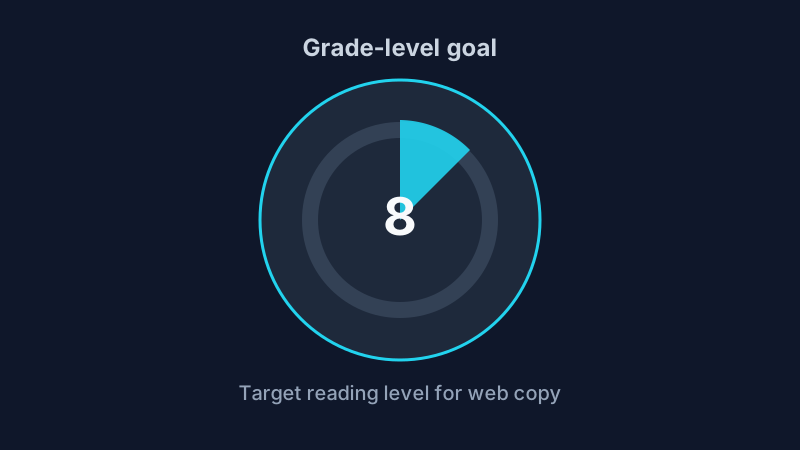
For everyday web and product writing, align targets with channel and audience—often middle-school to early high school bands for general audiences—and validate with qualitative feedback. Passive voice and jargon choices still matter even when ARI looks fine; metrics do not measure tone or trust.
Summary
The Automated Readability Index estimates grade level from characters per word and words per sentence, using:
ARI = 4.71(characters/words) + 0.5(words/sentences) − 21.43
Born from 1960s military documentation needs, ARI remains valuable because it is fast, deterministic, and implementation-stable. Compare it with Coleman–Liau as a fellow character-based index, and with Flesch–Kincaid and SMOG when syllable structure matters. Use SynthRead to view ARI beside other scores, edit the worst outliers, and re-measure until your draft matches both data and judgment.
ARI in your editing workflow
- Pick a convention — Define how you count characters (letters only vs letters + digits) and sentences (abbreviations, lists).
- Sample enough text — Very short passages produce noisy ARI values; prefer full sections or 200+ words when possible.
- Fix high-leverage sentences — Long sentences inflate words/sentence; long words inflate characters/word. Splitting one brutal sentence often helps more than tweaking synonyms.
- Cross-check — If ARI and Flesch–Kincaid disagree wildly, inspect syllable-heavy short words or odd segmentation.
Related Tools
- SynthRead — Automated Readability Index alongside other formulas and sentence-level guidance in one workspace.
Related Articles
- Flesch–Kincaid complete guide — Syllable-based grade level and reading ease.
- Gunning Fog index — Long-word and sentence-length “density.”
- SMOG readability index — Polysyllabic focus for health-style prose.
- Average sentence length and readability — Finding outliers that inflate ARI.
- Readability and SEO — How clarity supports engagement signals.

Itamar Haim
SEO & GEO Lead, SynthQuery
Founder of SynthQuery and SEO/GEO lead. He helps teams ship content that reads well to humans and holds up under AI-assisted search and detection workflows.
He has led organic growth and content strategy engagements with companies including Elementor, Yotpo, and Imagen AI, combining technical SEO with editorial quality.
He writes SynthQuery's public guides on E-E-A-T, AI detection limits, and readability so editorial teams can align practice with how search and generative systems evaluate content.
Related Posts
Gunning Fog Index: What It Is and How to Calculate It
A full guide to the Gunning Fog Index: history, the Grade Level = 0.4 × (ASL + PHW) formula, worked examples, score bands, limits, and how to lower your Fog score—plus when to pair it with Flesch-Kincaid.
SMOG Readability Index Explained (Formula, Scores, and When to Use It)
Learn how the SMOG grade is calculated, what a “good” score looks like for web and health content, and how it compares to Flesch–Kincaid—plus a practical editing workflow.
Average Sentence Length and Readability: Targets That Actually Work
Why mean sentence length shows up in so many formulas, what range to aim for by channel, and how to find the few sentences that drag your whole score down.
Get the best of SynthQuery
Tips on readability, AI detection, and content strategy. No spam.