Readability Scores and SEO: Do They Actually Affect Rankings?

- readability
- seo
- readability score
- content
What Google says about readability as a ranking factor, what large SEO studies measured, and how to improve clarity for users and AI-cited answers—without dumbing down your expertise.
If you manage content or SEO, you have seen the dashboards: Flesch Reading Ease, grade-level estimates, flags for long sentences. The promise is implicit—tune the score and watch rankings rise. The reality is messier. Readability score SEO is a useful editorial lens, not a direct dial on Google’s algorithm. This article separates what Google has actually said, what correlation studies found, and where readability still moves the needle: user behavior, links, and how clearly your page can be quoted in AI-driven results.
Does Google use readability as a ranking factor?
Google’s Search representatives have repeatedly pushed back on the idea that a single readability statistic—Flesch Reading Ease, Flesch–Kincaid grade level, or similar—is something the ranking systems optimize for directly.
What John Mueller has said
In public Q&A (including discussions summarized in the SEO press around 2018), John Mueller has stated that he is not aware of algorithms that use basic readability scores as a ranking input. That framing matters: it does not say “clear writing is irrelevant”; it says a mechanical score is not a lever you can crank for rankings. Third-party write-ups such as Search Engine Roundtable’s coverage of Google and reading levels document that thread for citation; Ahrefs’ Flesch study also references the same line of guidance.
Mueller has made a related point about “simple” quality heuristics: not every trait that correlates with good sites is a useful standalone ranking feature—partly because spam can mimic surface signals. Search Engine Journal’s recap of Google’s stance on why simplistic factors are not universal ranking signals expands that logic for SEOs who wonder why “fix grammar, rank #1” is not a viable playbook (SEJ: simple factors and ranking).
For foundational publisher guidance, Google’s own documentation on creating helpful, reliable, people-first content emphasizes usefulness and trust—not a target Flesch number. The Search Central documentation hub remains the canonical starting point when someone asks what Google says to do on-page.
How Gary Illyes fits into the picture
Gary Illyes (Google Search) often discusses overall page quality, content accuracy (including for sensitive topics), and how many signals combine in ranking—not a standalone “readability index.” Public interviews and conference recaps—for example, coverage of Illyes noting content accuracy as especially important in sensitive contexts—underscore that trust and correctness can outweigh stylistic polish when Google evaluates riskier queries (Search Engine Roundtable summary). There is no well-documented statement from Illyes that “Flesch–Kincaid must be 60–70” or similar. The takeaway for SEO is consistent with Mueller: optimize for clarity and correctness for your audience, not for a vendor’s green checkmark in isolation.
What Google does ask of content
Google’s public guidance stresses satisfying search intent, demonstrating experience and expertise where it matters, and avoiding thin or manipulative pages. Readability formulas do not appear in that checklist as a named system. That is why the honest answer to “Is readability a Google ranking factor?” is: not as a direct, documented score-based signal—even though readable pages can still win indirectly.
Historical footnote: Years ago, Google offered a reading level filter in advanced search; it was aimed at helping users choose simpler or harder sources—not at telling publishers which score to target for rankings. The filter is gone, but the episode still shows up in SEO threads as “proof” Google cares about grade level. The modern, better-supported takeaway is different: Google cares whether the page helps the searcher, and reading ease is one of many inputs to human satisfaction, not a leaked numeric requirement.
Correlation vs. causation: what the studies actually measured
Large-scale SEO studies are good at detecting broad correlations between page properties and ranking position. They are weaker at proving causation—that changing one property alone will move rankings—because SERPs reflect hundreds of overlapping variables (links, intent match, freshness, brand strength, SERP features, and more).
Portent’s crawl: hundreds of thousands of ranking URLs
Portent published a long-form write-up—“Study: How Content Readability Affects SEO and Rankings”—that remains one of the largest public attempts to test readability against organic positions. The team analyzed readability at scale—on the order of hundreds of thousands of ranking pages (with extended runs into the millions of URLs in follow-up tests)—using Flesch–Kincaid grade level and related checks. Their published conclusion: no meaningful correlation between reading grade level and ranking position, while the average reading level of ranking content tended to sit around an 11th-grade band (with Flesch Reading Ease means often landing in a band consistent with “fairly difficult” general-audience prose). In other words, top results are not “simpler” on average in a way that tracks position.
Portent also isolated dictionary-style domains to reduce skew and re-ran analyses; the headline finding held. That kind of robustness check matters for SEO discourse: a single odd SERP vertical can create illusory patterns if you do not slice the data.
Ahrefs: Flesch Reading Ease vs. rankings
Ahrefs ran a data study across thousands of keywords (grouped by topical verticals) and reported virtually zero correlation between Flesch Reading Ease and ranking positions. See Ahrefs’ write-up: “Flesch Reading Ease: Does It Matter for SEO? (Data Study).” They also showed that average FRE differs by topic—for example, their illustrative averages placed food content higher on the ease scale than engineering content, with marketing in between—not because Google “prefers pancakes to semiconductors,” but because language naturally follows subject matter and audience.
Backlinko’s ranking-factor work (context, not a readability lab)
Backlinko’s widely cited analysis of millions of Google search results is not a dedicated readability experiment, but it reinforces a related lesson SEOs often bundle with readability conversations: comprehensive, high-quality content tends to correlate with stronger performance than thin pages—measured through proxies like content grade or depth, depending on the methodology. That is not the same as “higher Flesch equals higher rank”; it is a reminder that substance and differentiation still dominate strategy. Where Backlinko’s ecosystem of studies intersects readability most directly is indirect: voice search result examples in their research often skew toward plain, conversational phrasing—useful for UX writing, not proof of a Flesch threshold in core web ranking.
Bottom line: the published correlation evidence argues against treating readability scores as a direct ranking driver—while still supporting readability as a user-quality and communication discipline.
How readability affects user signals (dwell time, bounce rate, pages per session)
Even if Google does not store your Flesch number as a ranking feature, readability shapes behavior—and behavior shapes outcomes SEOs care about.
Dwell time and engagement proxies
When copy is hard to parse—long sentences, undefined jargon, buried conclusions—readers stop, return to the SERP, or skim without scrolling. Those patterns can show up as shorter time on page, fewer meaningful interactions, and weaker downstream engagement. Google has been cautious about confirming specific click-level metrics as “the” ranking signal, but search engines are in the business of satisfying queries; pages that consistently fail real users tend to lose over time, whether through engagement, links, or brand signals.
You do not need a philosophical debate about “dwell time as a ranking factor” to justify editing: if people cannot finish your answer, they cannot trust it, share it, or return to your brand. Readability is one of the fastest ways to reduce avoidable friction on informational pages—especially on mobile, where long clauses and tiny tap targets compound each other.
Bounce rate: interpret with care
“Bounce” is not a uniform concept across sites. A dictionary-style answer may bounce quickly while still satisfying intent. What matters is whether your page’s bounce pattern reflects unmet intent versus fast satisfaction. Readable structure—headings, summaries, lists—helps the right readers stay and the wrong readers self-select quickly.
Pages per session and paths to conversion
Readable hubs make it easier to follow internal links, complete tasks, and trust the next click. That supports not only SEO-linked engagement metrics but revenue and lead quality—often a better internal argument for editing budgets than a hypothetical +2 Flesch points.
Core Web Vitals and readability: what connects (and what does not)
Core Web Vitals measure technical page experience—metrics like Largest Contentful Paint (LCP), Interaction to Next Paint (INP), and Cumulative Layout Shift (CLS)—not whether your sentences are short. A beautiful LCP score will not fix confusing prose.
Google’s own guidance treats Core Web Vitals as part of page experience signals; you can read the overview in Google’s documentation on Understanding Core Web Vitals and page experience. None of those metrics are “readability scores.”
Where the connection is real is indirect: clear layout and scannable content reduce frustration on mobile, help users find the “next” action faster, and can make heavy pages feel lighter when paired with performance work. Poor readability can increase rage clicks and abortive interactions—patterns that may show up as weak engagement even when your JavaScript is fast.
So the winning workflow pairs technical performance with editorial clarity—two different skill sets that meet at the user. If you are debating whether to spend the sprint on CLS fixes or sentence-level edits, choose based on what your analytics show: a slow LCP needs engineering; a high exit rate on scroll depth with fast paint needs editing.
Optimal readability levels for different content types and industries
There is no universal Flesch band that fits every query. Use ranges as guardrails, then validate with subject-matter experts and (when possible) user tests.
Suggested target ranges (illustrative)
These are practical editorial targets for general web audiences, not legal standards. Adjust up for expert readers and down for broad consumer health or safety instructions.
| Content type / industry | Typical audience | Flesch Reading Ease (illustrative band) | U.S. grade level (illustrative band) | Notes | | ---------------------- | ----------------- | ---------------------------------------- | ------------------------------------- | ----- | | Consumer lifestyle & e-commerce | Broad | ~60–75 | ~6–9 | Short sentences, concrete nouns, strong verbs. | | B2B marketing & SaaS blogs | Practitioners | ~45–65 | ~9–12 | Some jargon is fine if defined once. | | Legal, finance, healthcare (YMYL) | Mixed; often cautious | ~40–60 | ~10–14 | Accuracy and disclaimers beat fake simplicity. | | Developer docs & API guides | Specialists | ~30–50 | ~12–16 | Precision matters; use examples and code blocks. | | Academic & research summaries | Educated readers | ~30–45 | ~12+ | May stay “hard” by necessity; add plain-language abstracts. |
Ahrefs’ vertical comparison (e.g., food vs. engineering topics) is a useful reminder: winning pages in hard topics often score “hard” on Flesch because the language matches the problem space.
AI Overviews and AI citations: is readability a “citation factor”?
Generative summaries and AI-assisted search do not publish a public checklist, but clarity correlates with extractability: short sections, explicit definitions, and Q&A-style subheads are easier for systems (and humans) to lift as quotable passages.
SEMrush’s research into content qualities associated with AI platform citations—summarized in their article on how they built a content optimization lens for AI search—highlights factors such as clarity and summarization and section structure as strongly associated with citation-like outcomes in their modeling—alongside E-E-A-T-style signals. That aligns with a pragmatic SEO approach: write so a busy editor (or an automated snippet) can lift a defensible sentence without surrounding fluff.
Google’s public documentation on how AI Overviews work (including limitations and sourcing context) is worth reading alongside vendor studies: it reinforces that summaries are not endorsements of every detail on a page, which is why precision and quotability in your own headings and definitions still matter.
Practically, aim for:
- A lead answer in the first screen for informational queries.
- Heading-led sections that map to sub-questions.
- Atomic paragraphs (one idea each) with nouns and verbs that can stand alone when quoted.
Practical tips: optimize readability without dumbing down
1. Compress the cognitive load, not the ideas
Split long sentences, front-load conclusions, and move caveats to labeled “Note” lines. You keep the insight; you remove the maze.
2. Define terms once, then use them confidently
Expert readers resent oversimplification; they do not resent a three-word definition of an acronym on first use.
3. Use structure as a courtesy
Numbered steps, comparison tables, and bold lead sentences help every audience—especially mobile readers.
4. Edit the top 10% of hardest sentences first
Readability tools shine when you use them to prioritize edits, not to chase a single index.
5. Keep “difficulty” where the reader expects it
Legal, medical, and engineering pages may need Latin terms, precise quantities, or standard clauses. The readability move is not always “simpler words”—it is explicit structure: prerequisites, warnings, numbered steps, and a glossary when jargon density spikes.
6. Measure outcomes, not vanity scores
Track scroll depth, engaged time (where available), conversion paths, and assisted conversions from organic landing pages. If readability edits are working, you should see behavior change before you ever “prove” a ranking lift.
Before-and-after examples (same meaning, different friction)
These are stylized illustrations—your metrics will vary—but they show the pattern editors repeat in practice.
Example A: consumer health snippet
Before (higher friction): “It should be noted that adherence to the intervention, which was self-reported, was associated with outcomes that were modest in magnitude and should be interpreted cautiously given the limitations inherent in observational designs.”
After (lower friction): “People who stuck with the plan—by their own report—saw small improvements. Because this wasn’t a randomized trial, treat the result as suggestive, not definitive.”
Example B: B2B product explanation
Before: “Our solution leverages a microservices-oriented architecture to enable robust, enterprise-grade scalability across multi-tenant deployments.”
After: “The system runs as small services you can scale independently—so one noisy customer workload is less likely to slow everyone else.”
Same claims; the second version names actors, uses plain verbs, and stores jargon only where it earns its keep.
Tools for measuring and improving readability (including SynthQuery)
- SynthRead (/synthread) — Grade-level estimates, multiple classic formulas (including Flesch-style metrics), and sentence-level highlights so you fix the worst lines first—without flattening voice across the whole draft.
- Word Counter — Fast length, density, and light readability stats when you are shaping snippets or social cuts.
- AI-assisted checks — If you need to screen drafts for templated or model-like phrasing before publication, pair readability work with an AI Detector pass where policy requires it—editorial judgment still leads.
Readability tools work best as shared editorial standards: a number your team agrees means “ship,” plus a second pass for topic fit machines cannot score.
Key takeaways
- Google’s public messaging does not support treating Flesch or grade-level formulas as direct ranking factors; John Mueller has specifically distanced basic readability scores from algorithmic use in the way SEOs sometimes imagine.
- Large studies (including Portent’s and Ahrefs’ published work) find little to no correlation between readability metrics and ranking positions—while confirming that average difficulty varies by topic.
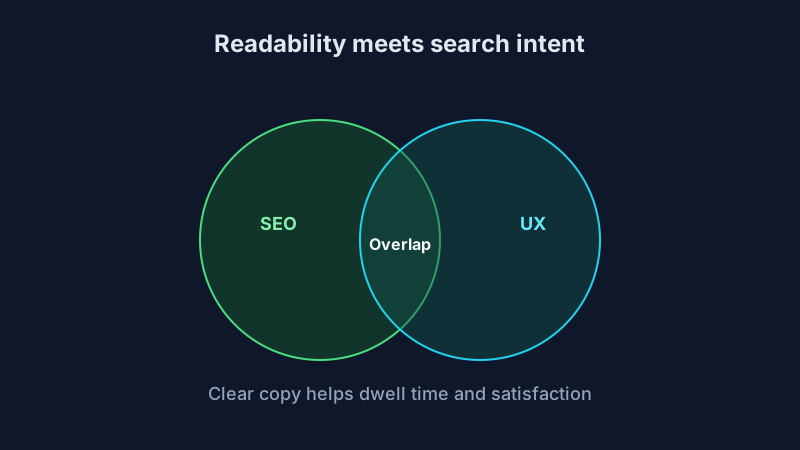
- Readability still matters for comprehension, engagement, conversions, linkability, and passage-friendly writing in AI-heavy SERPs—goals that overlap with SEO even when the score itself is not a knob.
- Optimize for humans first, use metrics to prioritize edits, and keep expertise explicit—especially in YMYL and technical spaces where “simpler” must never mean wrong.
Further reading (official docs + cited studies)
- Google Search Central — Creating helpful, reliable, people-first content
- Google Search Central — Understanding Core Web Vitals and page experience
- Portent — Study: How Content Readability Affects SEO and Rankings
- Ahrefs — Flesch Reading Ease: Does It Matter for SEO? (Data Study)
- Backlinko — We Analyzed 11.8 Million Google Search Results
- SEMrush — How We Built a Content Optimization Tool for AI Search (Study)
- Search Engine Roundtable — Google on reading levels / algorithm (Mueller discussion)
Related Tools
- SynthRead — Readability formulas, sentence highlights, and consistent baselines for writers and editors.
Related Articles
- Flesch–Kincaid complete guide — Reading ease vs. grade level in practice.
- Writing for grade 8 — Broad-audience targets without talking down to readers.
- How AI detectors work — What statistical detection measures (and what it does not).
- Internal linking for topical authority — Structure that supports discovery beyond any single page’s readability.
- Meta descriptions that earn clicks — Pair readable bodies with compelling SERP snippets.

Itamar Haim
SEO & GEO Lead, SynthQuery
Founder of SynthQuery and SEO/GEO lead. He helps teams ship content that reads well to humans and holds up under AI-assisted search and detection workflows.
He has led organic growth and content strategy engagements with companies including Elementor, Yotpo, and Imagen AI, combining technical SEO with editorial quality.
He writes SynthQuery's public guides on E-E-A-T, AI detection limits, and readability so editorial teams can align practice with how search and generative systems evaluate content.
Related Posts
Does Google Penalize AI Content?
What Google’s helpful-content and spam guidance actually say about AI-assisted publishing, E-E-A-T, thin content risk, and how to audit drafts with detection and SynthRead.
Alt Text and Captions: SEO Value Without Keyword Stuffing
How alt attributes help accessibility and image search, when captions beat alt, and patterns for charts, products, and decorative visuals.
The Legal Status of AI-Generated Content: Copyright, Disclosure, and Detection
A practical overview of U.S. and international rules on AI-generated works: Copyright Office practice, EU labeling, FTC disclosure expectations, state AI laws, academic and publishing norms, Google’s guidance, and where detection tools fit in compliance workflows.
Get the best of SynthQuery
Tips on readability, AI detection, and content strategy. No spam.