Flesch-Kincaid Readability: The Complete Guide (With Calculator)

- readability
- flesch-kincaid
- writing
- seo
The definitive guide to Flesch-Kincaid readability scores: exact formulas, Navy history, interpretation tables, industry benchmarks, limitations, comparisons to Fog and SMOG, SEO guidance, and how to improve your score—with worked examples.
The Flesch-Kincaid readability score family turns two simple statistics—how long your sentences are and how many syllables your words use—into either a Reading Ease number from 0 to 100 or a U.S. grade level. It is not a measure of “good writing,” but it is one of the most widely cited shorthand metrics in education, government plain-language programs, healthcare communication, and content strategy.
This guide gives you the exact formulas, worked examples, interpretation tables, limitations, industry benchmarks, comparisons to other readability formulas, practical editing tactics, SEO context, and tools (including SynthRead on SynthQuery) so you can use Flesch-Kincaid as a compass—not a verdict.
Who created Flesch–Kincaid—and why does Navy context matter?
Flesch and the Reading Ease line
Rudolf Flesch (1911–1986) was an Austrian-born readability researcher and writing consultant who became known for advocating plain language in English. His landmark paper, “A New Readability Yardstick,” appeared in the Journal of Applied Psychology in 1948 and introduced what we now call Flesch Reading Ease: a formula based on average sentence length (words per sentence) and average syllable load (syllables per word). The goal was practical—produce a repeatable score editors could use to compare drafts and instructional materials.
Kincaid, the Navy, and grade level
J. Peter Kincaid and colleagues at the U.S. Navy later helped derive a companion metric that expresses the same underlying statistics as an approximate U.S. school grade. The work is widely associated with a 1975 Navy technical report on automated readability formulas for training materials (Derivation of New Readability Formulas…, often cited by its DTIC identifier). That context matters: the formulas were validated for instructional and technical prose—manuals, training modules, policies—not poetry, dialogue, slogans, or UI microcopy where sentence boundaries are odd.
Why the history still matters
Flesch-Kincaid scores describe surface complexity (length and syllables). They do not, by themselves, measure factual accuracy, argument quality, or whether a reader cares about the topic.
The two Flesch-Kincaid formulas (exact equations)
Use the same three counts for both formulas:
- W = total words in the sample
- S = total sentences
- Y = total syllables
Flesch Reading Ease
Flesch Reading Ease = 206.835 − 1.015 × (total words ÷ total sentences) − 84.6 × (total syllables ÷ total words)
Equivalently:
Flesch Reading Ease = 206.835 − 1.015 × (words per sentence) − 84.6 × (syllables per word)
Interpretation: Higher scores mean easier reading on average. The output is typically discussed on a 0–100 scale (scores can fall slightly outside that range on very easy or very hard samples).
Flesch-Kincaid Grade Level
Flesch-Kincaid Grade Level = 0.39 × (total words ÷ total sentences) + 11.8 × (total syllables ÷ total words) − 15.59
Or:
0.39 × (words per sentence) + 11.8 × (syllables per word) − 15.59
Interpretation: The result is expressed as a U.S. grade (e.g., 8.2 ≈ early eighth grade). Values can rise above 12 for dense academic or legal prose.
Both formulas punish long sentences and long words—measured indirectly through syllable counts.
Why two formulas from the same inputs?
Reading Ease and Grade Level are not independent checks—they are two views of the same averages. One team can track a 0–100 target while another policy cites “grade 8 or lower.” If they ever seem to “disagree,” re-check sentence boundaries first—both are sensitive to the same parsing errors.
Step-by-step: use the formulas like a calculator
Pick a stable sample
- Pick a sample of at least 100 words for stable averages (longer is fine; very short snippets bounce around).
Count W, S, and Y consistently
- Count sentences using end punctuation. Treat lists and dialogue carefully—splitting rules change scores.
- Count words with the same rules your software uses if you are verifying a tool.
- Count syllables per word and sum to Y (slow by hand—most people use a syllabifier).
Plug averages into both formulas
- Compute words per sentence = W ÷ S and syllables per word = Y ÷ W.
- Plug those two averages into both formulas and compare to your editorial targets.
If you only need a quick diagnostic, compute words per sentence and syllables per word first—those two numbers explain almost every shift between drafts.
How should you count words, sentences, and syllables?
Before you plug numbers in, align your counting rules—different tools can disagree slightly.
- Words: Tokens separated by whitespace; numbers and hyphenated forms may be counted as one word depending on the implementation.
- Sentences: Usually split on end punctuation (
.,?,!). Bullet lines without terminal punctuation may be treated oddly—put true sentences on their own lines for stable scoring. - Syllables: Typically approximated with vowel-group heuristics (e.g., read = 1 syllable, reading = 2). Edge cases (create, science, acronyms) are where human and algorithm counts diverge.
Editorial tip: pick one tool as your source of truth for before/after comparisons. If you switch tools mid-project, you are partly measuring implementation differences, not just your edits.
Common mistakes that skew Flesch-Kincaid
People new to these metrics often paste navigation, cookie banners, or image alt text into the analyzer and wonder why the grade explodes. Run scores on body copy only. Others forget that URLs, code samples, and legal boilerplate are still words—exclude them when you want a fair editorial reading. A third pitfall is one-sentence paragraphs: they look “easy,” but if each sentence is long and every word is three syllables, your syllables-per-word average stays high. Finally, remember Flesch-Kincaid is English-centric; mixed-language pages need segmented analysis, not one blended paste.
Worked example 1: hand calculation on a short passage
Passage and counts
Passage (one sentence, 17 words):
The team published a shorter report so readers could scan the key results in under a minute.
Assume counting yields:
- W = 17
- S = 1
- Y = 24 (depends on syllabifier; your tool may differ by a syllable or two)
Averages before the formulas
Compute averages:
- Words per sentence: 17 ÷ 1 = 17
- Syllables per word: 24 ÷ 17 ≈ 1.412
Reading Ease and Grade Level
Flesch Reading Ease
206.835 − 1.015 × (17) − 84.6 × (1.412) ≈ 206.835 − 17.255 − 119.455 ≈ 70.1
Flesch-Kincaid Grade Level
0.39 × (17) + 11.8 × (1.412) − 15.59 ≈ 6.63 + 16.66 − 15.59 ≈ 7.7
So this sample lands around Reading Ease ≈ 70 (“standard” plain English territory for many audiences) and Grade Level ≈ 7.7—broadly consistent with “upper middle school” statistical complexity, even if your readers are adults.
Worked example 2: real paragraph with multiple sentences
Passage and totals
Passage:
Public agencies often publish dense notices. Readers abandon them. Short sentences help. Define terms early.
Assume:
- W = 20
- S = 4
- Y = 38
Averages
Averages:
- Words per sentence: 20 ÷ 4 = 5
- Syllables per word: 38 ÷ 20 = 1.9
Scores and takeaway
Reading Ease ≈ 206.835 − 1.015 × (5) − 84.6 × (1.9) = 206.835 − 5.075 − 160.74 ≈ 41.0
Grade Level ≈ 0.39 × (5) + 11.8 × (1.9) − 15.59 = 1.95 + 22.42 − 15.59 ≈ 8.8
Even with simple words, a high syllables-per-word average (here, 1.9) can drag Reading Ease down and push grade level up—showing why syllable-heavy drafting matters as much as sentence length.
Score interpretation table (Flesch Reading Ease)
Map Reading Ease to school levels (roughly)
Reading Ease is not a “grade,” but people often map it to approximate U.S. school levels. Treat this as a rough guide, not a clinical diagnosis:
| Flesch Reading Ease | Typical description | Approximate U.S. school level | | --- | --- | --- | | 90–100 | Very easy | ~5th grade | | 80–90 | Easy | ~6th grade | | 70–80 | Fairly easy | ~7th grade | | 60–70 | Standard / plain English | ~8th–9th grade | | 50–60 | Fairly difficult | ~10th–12th grade | | 30–50 | Difficult | College | | 0–30 | Very difficult | College graduate |
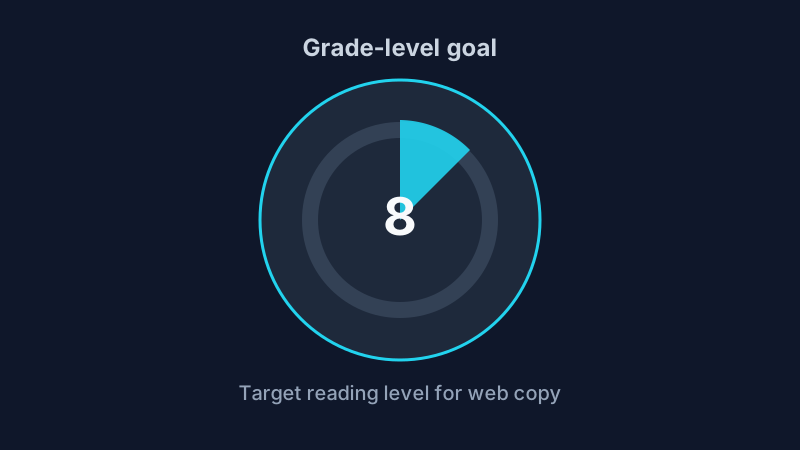
Many public-facing web teams aim for grade 8 as a plain-language target for broad U.S. audiences—often discussed alongside Flesch-Kincaid Grade Level and Reading Ease together; see writing for an eighth-grade reading level.
Flesch-Kincaid Grade Level: quick audience mapping
Grade level is not a guarantee that someone at that grade will understand domain content—it is a statistical match to typical school-text complexity. Use this alongside your own audience research:
| Flesch-Kincaid grade (approx.) | Often used for | | --- | --- | | 6–8 | General public web content, patient handouts, civic information | | 8–10 | Mainstream journalism, product marketing, many blogs | | 10–12 | General business, trade press, informed consumers | | 12+ | High-complexity surface stats; often understates burden for technical topics | | 16+ | Dense legal, medical, or academic prose—may be appropriate for credentialed readers, not for the general public |
When medical content is meant for patients, many institutions still aim near grade 6–8 for safety-critical understanding. When it is written for clinicians, grade 12+ is common because terminology is long by necessity. Legal drafting for the public is increasingly pushed toward plain language; contracts and statutes often land grade 16+ if you run them unedited—another reason to add summaries and defined terms.
What does Flesch–Kincaid fail to measure?
Comprehension and “understanding”
Flesch-Kincaid does not measure whether a reader understands the content. A clear explanation of quantum computing can score “hard” because the terms are long and sentences are precise. A misleading article with short sentences can score “easy.”
Cultural and linguistic bias
The grade scale is tied to U.S. schooling norms. It can misrepresent texts for non-native English speakers, multilingual audiences, or communities with different educational backgrounds. It also struggles with proper nouns, quoted material, and domain jargon that is easy for insiders but polysyllabic on paper.
Context and genre
Poetry, interviews, regulatory citations, and UI strings break sentence parsers. Irony, implied premises, and missing definitions are invisible to the formula. A “good score” cannot rescue weak structure—see long sentences: how to split and passive voice: why it matters for patterns formulas miss.
Gaming the metric
Writers can artificially shorten sentences and swap in simple words while hiding vagueness or omitting needed nuance. Treat the score as a diagnostic, not a moral judgment.
Industry benchmarks: who targets what reading level?
Accessibility vs. precision tradeoffs
Different fields balance accessibility, precision, and legal defensibility. These are common targets, not universal laws:
Benchmarks by industry
| Industry / use case | Typical target | Notes | | --- | --- | --- | | Mainstream journalism / digital news | ~Grade 8–10 (varies by outlet) | Speed and clarity compete with nuance. | | Consumer marketing & support | ~Grade 6–8 for broad audiences | Shorter sentences and concrete verbs. | | Public health / patient education | Often ~Grade 6–8 | Plain language reduces harm from misunderstanding. | | Medical (clinical / professional audience) | Often Grade 12+ | Long terminology; pair with structure and headings for specialists. | | General legal (public-facing) | Often Grade 10–14+ depending on jurisdiction | Plain-language initiatives still push lower where possible. | | Legal (contracts, statutes, filings) | Often Grade 16+ if unedited | Requires summaries, plain-language annexes, or lawyer mediation for lay readers. | | Technical / B2B white papers | Grade 12–16+ is common | Specialized vocabulary raises syllable counts. | | Academic / research summaries | Wide range; often “hard” on purpose | Precision and citation density inflate scores. |
When you move from “general public” to “licensed professional,” higher grade levels can be appropriate—as long as you still optimize structure (headings, definitions, examples) for human readers.
When higher grade level is OK
Specialist audiences may need dense terms—pair high scores with summaries, glossaries, and clear headings so skimmers and experts both succeed.
How does Flesch–Kincaid compare to Fog, SMOG, and other formulas?
Why teams run multiple formulas
No single index wins every document. Practitioners often compare multiple metrics to see why a draft feels heavy.
Comparison at a glance
| Formula | Core inputs (typical) | Output | What it emphasizes | Best when | | --- | --- | --- | --- | --- | | Flesch Reading Ease | Words/sentence, syllables/word | 0–100 (typical) | Overall ease on a familiar scale | Quick benchmarking and policy tables | | Flesch-Kincaid Grade Level | Same as above | U.S. grade | Audience translation of the same inputs | “Write at or below grade X” requirements | | Gunning Fog | Words/sentence, complex words | Approx. years of formal education | Long words + long sentences | Corporate and B2B prose that feels “dense” | | SMOG | Polysyllabic words, sentences | Grade estimate | Multi-syllable load | Health literacy workflows | | Coleman–Liau | Characters/words, sentences | Grade estimate | Relies on characters instead of syllable counting | When syllable algorithms are unstable | | Dale–Chall | Sentence length + “hard” word list | Grade estimate | Vocabulary familiarity vs a reference list | Texts where common words dominate |
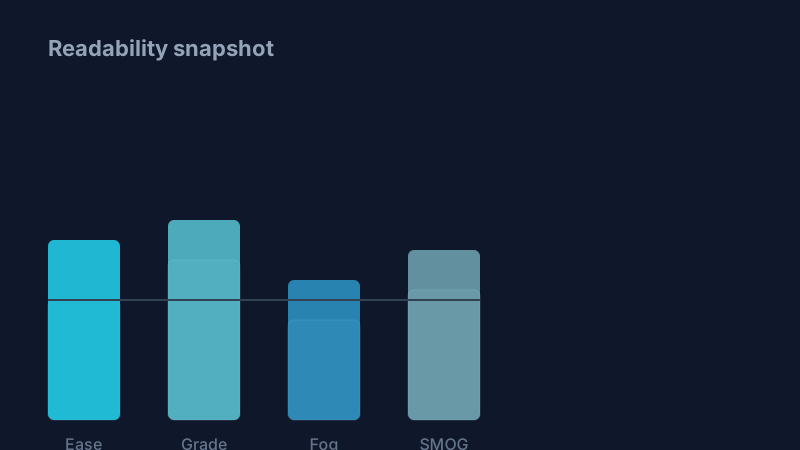
If Fog is high but Flesch-Kincaid looks moderate, you may have long Latinate words, not just long sentences—compare with Gunning Fog and SMOG.
Pick one headline metric for writers
Choose either Reading Ease or Grade Level as your primary dashboard number, then use Fog/SMOG as secondary severity checks—consistent vocabulary beats debating three “best” scores.
How can you improve your Flesch–Kincaid score while preserving meaning?
1. Shorten the longest sentences first
Mean sentence length is a direct lever. Split overloaded sentences, remove throat-clearing clauses, and put one main idea per sentence. See average sentence length.
Before:
We decided to postpone the launch, which had originally been scheduled for Monday, because several dependencies were still unresolved, although marketing had already prepared assets.
After:
We postponed Monday’s launch. Dependencies were still open. Marketing had assets ready, but shipping would have been risky.
2. Swap polysyllabic jargon for plain terms (when accurate)
Before: utilize → After: use
Before: methodology → After: method (if truly interchangeable)
Keep technical terms when precision matters—then define them once.
3. Prefer strong verbs over nominalizations
Before: We conducted an analysis of the dataset.
After: We analyzed the dataset.
4. Watch lists and quotes
Bullets can create false “sentences.” Long quoted passages can dominate syllable averages. Consider paraphrasing quotes or scoring body copy separately from appendices.
5. Align voice and tone across teams
Inconsistent drafts confuse readers even when the headline scores well. Pair numeric targets with a shared voice and tone guide.
Readability scores and SEO: what Google rewards (indirectly)
Google does not publish a public “Flesch-Kincaid ranking factor.” What is observable in SEO practice is that clear, satisfying content tends to earn better engagement signals (time on page, pogo-sticking patterns, helpfulness relative to intent). Accessible writing supports:
- Skimmability (headings, short paragraphs)
- Broader audience match for informational queries
- Snippet-friendly definitions and lists
Use readability metrics as part of a quality system—alongside E-E-A-T considerations, accurate sourcing, and alignment with search intent—not as a gimmick to “trick” algorithms. For a broader framing, see readability and SEO.
Practical SEO checklist (readability-aware)
- Match intent first — Answer the question in the first screen; readability scores cannot fix wrong intent.
- Put definitions before jargon — Lower perceived difficulty even when the topic is inherently complex.
- Use headings as an outline — Readers scan; headings reduce bounce even when raw grade level is high.
- Split “reference” blocks — Move long quotes, citations, and regulatory text into appendix sections or footnotes so your main narrative scores closer to your target.
- Measure twice — Check Flesch-Kincaid on the intro, each H2, and FAQ separately; sitewide averages lie.
Google’s systems continue to emphasize helpful content and people-first pages. Readability scores are a writer’s instrument for aligning with those expectations—not a substitute for expertise or originality.
Accessibility, WCAG, and readability
Numeric readability scores are not a replacement for WCAG 2.2 success criteria. They pair well with plain-language habits: meaningful headings, consistent terms, instructions that name the action. If you serve broad public audiences, treat plain language and accessible structure as requirements; Flesch-Kincaid is one dial on the panel.
Tools for measuring readability (including SynthQuery)
Word processors and built-in stats
- Word processors sometimes include Flesch-Kincaid in proofing settings—convenient, but often opaque about syllable rules.
Calculators and extensions
- Browser extensions and one-off calculators vary widely; validate against a known sample if you need consistency.
SynthRead as an editorial workspace
- SynthRead (SynthQuery) — paste text for Flesch Reading Ease, Flesch-Kincaid grade level, Gunning Fog, SMOG, and related metrics with sentence-level highlights so you can see where complexity concentrates, not just the headline numbers. It is designed for writers and editors who want a workspace-style pass before publishing.
Tip: score per section (each major H2) for long pages. Whole-page averages can hide a brutal FAQ or dense disclaimer in the middle.
When to trust the number—and when to ignore it
When the score earns a seat at the table
Use Flesch-Kincaid when you need:
- Before/after comparisons on the same draft
- A shared benchmark across writers and reviewers
- A plain-language checkpoint for regulated or safety-critical content
When to slow down and add humans
Pause and add human review when:
- The topic requires specialized vocabulary
- The audience expects density (e.g., peer-facing methods sections)
- The text includes nonstandard formatting that breaks parsers
Frequently asked questions
Is a higher Flesch Reading Ease always better?
No. Higher ease can mean oversimplification or vagueness for expert audiences. Match the score to reader goals and risk.
Why do two tools give different Flesch-Kincaid scores?
Usually sentence splitting, syllable counting, or which text is included (navigation, footers, references).
Can Flesch-Kincaid exceed grade 12?
Yes. Very long words and long sentences can push Flesch-Kincaid Grade Level well above 12 even when the passage is “appropriate” for specialists.
Related reading
Sources and further reading
- Flesch, R. “A New Readability Yardstick.” Journal of Applied Psychology, 1948 (PsycNet record).
- Kincaid et al., Derivation of New Readability Formulas… U.S. Navy, 1975 (DTIC citation).
- Nielsen Norman Group — Flesch-Kincaid readability scores.
- U.S. federal plain language guidance — plainlanguage.gov.
Try it: run your draft through SynthRead on SynthQuery to see Flesch-Kincaid alongside other formulas and sentence-level highlights—then edit with intent, not superstition. Bookmark this page if you want a single reference for formulas, tables, and benchmarks.

Itamar Haim
SEO & GEO Lead, SynthQuery
Founder of SynthQuery and SEO/GEO lead. He helps teams ship content that reads well to humans and holds up under AI-assisted search and detection workflows.
He has led organic growth and content strategy engagements with companies including Elementor, Yotpo, and Imagen AI, combining technical SEO with editorial quality.
He writes SynthQuery's public guides on E-E-A-T, AI detection limits, and readability so editorial teams can align practice with how search and generative systems evaluate content.
Related Posts
How to Write for a Grade 8 Reading Level (And Why You Should)
A practical guide to writing for a grade 8 reading level—the common standard for web content. Learn why it matters, how literacy and research back it up, techniques that work, mistakes to avoid, tools to measure level, and five before-and-after rewrites.
Coleman-Liau Index: Formula, Examples, and When to Use It
A practical guide to the Coleman-Liau readability formula: how it works, worked examples, comparisons with syllable-based scores, and when to choose it in automated pipelines.
Dale-Chall Readability Formula: The Most Accurate Readability Test?
How the Dale-Chall formula uses a familiar-word list to estimate reading grade level, why researchers often prefer it to syllable-only metrics, and when to pair it with Flesch-Kincaid or SMOG.
Get the best of SynthQuery
Tips on readability, AI detection, and content strategy. No spam.