SMOG Readability Index Explained (Formula, Scores, and When to Use It)

- SMOG
- readability
- grade level
- editing
Learn how the SMOG grade is calculated, what a “good” score looks like for web and health content, and how it compares to Flesch–Kincaid—plus a practical editing workflow.
What SMOG is
Polysyllables and health literacy
The SMOG (Simple Measure of Gobbledygook) index estimates the years of education needed to understand a text. It focuses on polysyllabic words (roughly three or more syllables) and sentence count in a sample. It was designed with health literacy in mind: patient leaflets, consent forms, and public-health messaging where misunderstanding has real consequences.
How it differs from “ease” scores
Unlike pure “ease” scores, SMOG outputs a grade-like number that many compliance and medical editors recognize.
Why teams use SMOG
Shared vocabulary with reviewers
If your organization already reports SMOG alongside other metrics, you keep one shared vocabulary with reviewers and legal. For general marketing copy, SMOG is still useful as a severity check on jargon and long words—even if Flesch–Kincaid is your day-to-day headline metric.
Interpreting scores by audience
Very roughly, lower SMOG means fewer long words per sentence and an easier read. Targets depend on audience: lay readers often aim for single-digit to low-teen SMOG-style results, while expert audiences tolerate higher numbers. Always pair the number with user testing or support tickets: if people misread instructions, the score is too optimistic.
Editing workflow
Step-by-step in SynthRead
(1) Run a full readability pass in SynthRead and note SMOG next to Flesch–Kincaid. (2) Sort edits by polysyllabic nouns you can swap for shorter terms (utilization → use). (3) Split sentences that exist mainly to carry stacked jargon. (4) Re-run after each pass so you see which changes moved the needle. (5) Document house targets so freelancers don’t chase the wrong metric.
Compare with Flesch–Kincaid in the same pass
Seeing SMOG move together with grade level helps you tell whether edits helped word length, sentence shape, or both.
Limits
Domain vocabulary and proper nouns
SMOG can misread brand names, drug names, and acronyms as “hard” when your audience knows them cold. Maintain a glossary for terms that are long on paper but obvious to readers.
What structure and layout don’t capture
It doesn’t measure structure, headings, or visual hierarchy—a wall of text with a good SMOG score can still exhaust readers. Pair with layout and alt text discipline for charts.
Pair SMOG with other signals
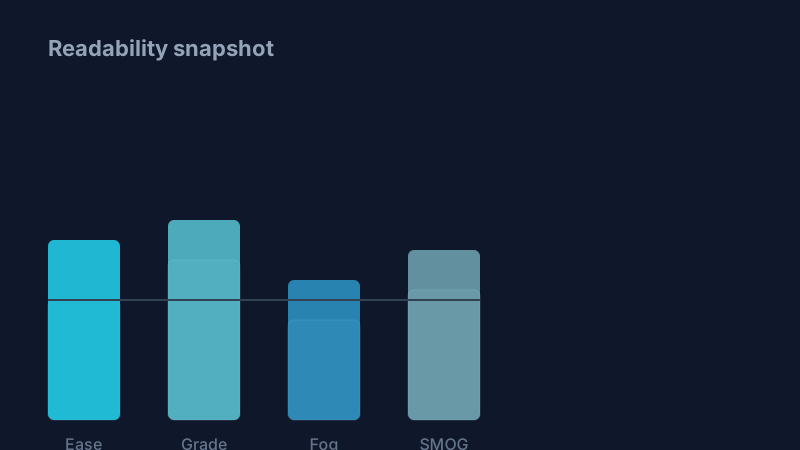
Use SMOG as one input: combine with Flesch–Kincaid, Gunning Fog, and SynthRead sentence highlights so you don’t optimize one number while ignoring confusion.
Related reading
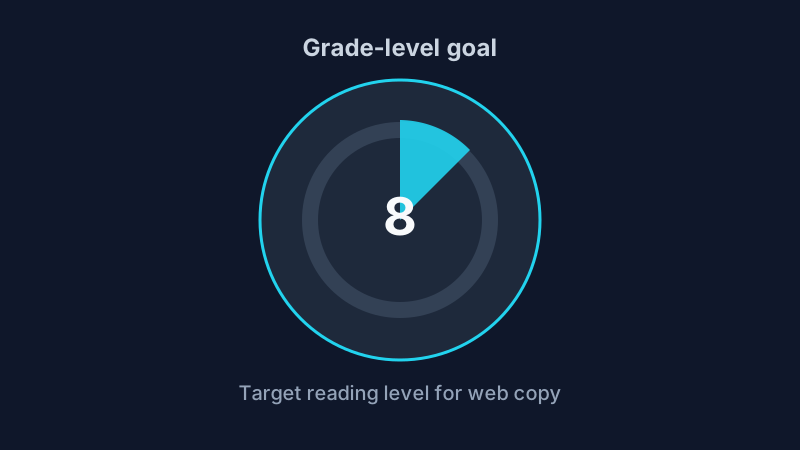
Compare with our Flesch–Kincaid complete guide and writing for an eighth-grade reading level.
When SMOG is your lead metric
Health, consent, and regulated copy
SMOG shines when long words drive misunderstanding—patient information, consent language, or any copy where misreads have cost.
When Fog or Flesch–Kincaid should lead instead
Stack SMOG with Flesch–Kincaid for a fuller picture, and use Gunning Fog when bureaucratic stacking is the main issue. SynthRead shows SMOG next to other scores so you don’t optimize one formula while breaking another.
Tying SMOG work to SEO outcomes
For web content tied to rankings, connect targets to readability and SEO; for sentence mechanics, average sentence length remains the fastest edit loop.
Related Tools
- SynthRead — SMOG, Flesch–Kincaid, Gunning Fog, and highlighted sentences in one pass.
Related Articles
- Flesch–Kincaid complete guide — Syllables, grade level, and reading ease.
- Gunning Fog explained — “Fog” from long words and sentence sprawl.
- Writing for grade 8 — Audience-appropriate targets without dumbing down.
- Long sentences: how to split them — Surgical edits that reduce polysyllabic load.

Itamar Haim
SEO & GEO Lead, SynthQuery
Founder of SynthQuery and SEO/GEO lead. He helps teams ship content that reads well to humans and holds up under AI-assisted search and detection workflows.
He has led organic growth and content strategy engagements with companies including Elementor, Yotpo, and Imagen AI, combining technical SEO with editorial quality.
He writes SynthQuery's public guides on E-E-A-T, AI detection limits, and readability so editorial teams can align practice with how search and generative systems evaluate content.
Related Posts
Gunning Fog Index: What It Is and How to Calculate It
A full guide to the Gunning Fog Index: history, the Grade Level = 0.4 × (ASL + PHW) formula, worked examples, score bands, limits, and how to lower your Fog score—plus when to pair it with Flesch-Kincaid.
ARI (Automated Readability Index): Formula and Practical Guide
Learn how the Automated Readability Index works, why it counts characters instead of syllables, how to interpret ARI scores against US grade levels, and when ARI beats—or falls short of—formulas like Coleman-Liau and Flesch–Kincaid.
Average Sentence Length and Readability: Targets That Actually Work
Why mean sentence length shows up in so many formulas, what range to aim for by channel, and how to find the few sentences that drag your whole score down.
Get the best of SynthQuery
Tips on readability, AI detection, and content strategy. No spam.